
|
You entered: light
 Pick a Galaxy Any Galaxy
17.01.2002
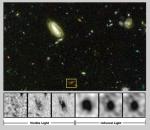
Pick a galaxy, any galaxy. In the top panel you can choose from a myriad of distant galaxies revealed in a deep Hubble Space Telescope image of a narrow slice of the cosmos toward the constellation Hercules.
 NGC 253: Dusty Island Universe
21.11.2009
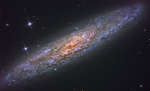
Shiny NGC 253 Galaxy, is one of the brightest spiral galaxies visible, and also one of the dustiest. Some call it the Silver Dollar Galaxy for its appearance in small telescopes, or just the Sculptor Galaxy for its location within the boundaries of the southern constellation Sculptor.
 The Case of the Missing Supernova Companion
12.01.2012
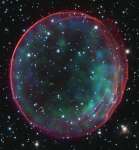
Where's the other star? At the center of this supernova remnant should be the companion star to the star that blew up. Identifying this star is important for understanding just how Type...
 The Galactic Center from Radio to X ray
31.03.2020
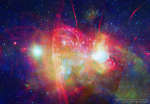
In how many ways does the center of our Galaxy glow? This enigmatic region, about 26,000 light years away toward the constellation of the Archer (Sagittarius), glows in every type of light that we can see.
 APOD: 2023 September 4 Б Cygnus: Bubble and Crescent
4.09.2023
As stars die, they create clouds. Two stellar death clouds of gas and dust can be found toward the high-flying constellation of the Swan (Cygnus) as they drift through rich star fields in the plane of our Milky Way Galaxy.
 What are Comet Tails Made Of?
26.03.1996
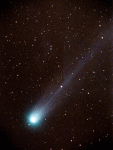
The tail of comet Hyakutake, visible in this recent color image, is composed of dust and gas driven off the icy comet nucleus by the Sun's heat and blown away by the solar wind. Bathed in solar ultraviolet light, the gas molecules break down and are excited, producing a characteristic glow.
 X Rays From Tycho s Supernova Remnant
12.09.2002
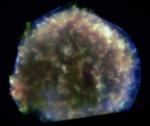
In 1572, Danish astronomer Tycho Brahe recorded the sudden appearance of a bright new star in the constellation Cassiopeia. The new star faded from view over a period of months and is believed to have been a supernova, one of the last stellar explosions seen in our Milky Way galaxy.
 Crab Pulsar Wind Nebula
27.12.2008
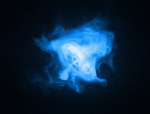
The Crab Pulsar, a city-sized, magnetized neutron star spinning 30 times a second, lies at the center of this remarkable image from the orbiting Chandra Observatory. The deep x-ray image gives the first clear view of the convoluted boundaries of the Crab's pulsar wind nebula.
 From the Galactic Plane through Antares
2.07.2018
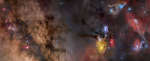
Behold one of the most photogenic regions of the night sky, captured impressively. Featured, the band of our Milky Way Galaxy runs diagonally along the far left, while the colorful Rho Ophiuchus region including...
 GRB 221009A
15.10.2022
Gamma-ray burst GRB 221009A likely signals the birth of a new black hole, formed at the core of a collapsing star long ago in the distant universe. The extremely powerful blast is depicted in this animated gif constructed using data from the Fermi Gamma Ray Space Telescope.
|
January February March April May June July August September October |
|||||||||||||||||||||||||||||||||||||||||||||||||