
|
You entered: light
 Arp 87: Merging Galaxies from Hubble
9.12.2015
This dance is to the death. Along the way, as these two large galaxies duel, a cosmic bridge of stars, gas, and dust currently stretches over 75,000 light-years and joins them. The bridge...
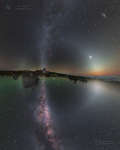 Two Hemisphere Night Sky
27.02.2020
The Sun is hidden by a horizon that runs across the middle in this two hemisphere view of Earth's night sky. The digitally stitched mosaics were recorded from corresponding latitudes, one 29 degrees north and one 29 degrees south of the planet's equator.
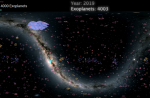 4000 Exoplanets
14.08.2022
Over 4000 planets are now known to exist outside our Solar System. Known as exoplanets, this milestone was passed last month, as recorded by NASA's Exoplanet Archive. The featured video highlights these exoplanets in sound and light, starting chronologically from the first confirmed detection in 1992 and continuing into 2019.
 APOD: 2025 May 4 Б Spin up of a Supermassive Black Hole
4.05.2025
How fast can a black hole spin? If any object made of regular matter spins too fast -- it breaks apart. But a black hole might not be able to break apart -- and its maximum spin rate is really unknown.
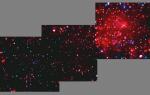 X Ray Stars and Winds in the Rosette Nebula
19.10.2001
This mosaic of x-ray images cuts a swath across the photogenic Rosette Nebula, a stellar nursery 5,000 light-years from Earth in the constellation Monoceros, the Unicorn. Constructed from data recorded by the orbiting...
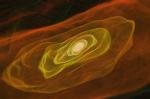 Zooming in on the First Stars
10.06.2003
What became of the first stars? No known stars appear to be composed of truly primordial gas -- all of the stars around us have too many heavy elements. Our own Sun is thought to be a third generation star, with many second-generation stars seen in globular clusters.
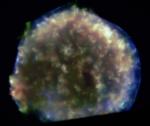 X Rays From Tycho s Supernova Remnant
22.05.2004
In 1572, Danish astronomer Tycho Brahe recorded the sudden appearance of a bright new star in the constellation Cassiopeia. The new star faded from view over a period of months and is believed to have been a supernova, one of the last stellar explosions seen in our Milky Way galaxy.
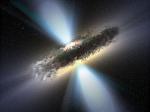 Molecular Torus Surrounds Black Hole
8.09.2004
Why do some black hole surroundings appear brighter than others? In the centers of active galaxies, supermassive black holes at least thousands of times the mass of our Sun dominate. Many, called Seyfert Type I, are very bright in visible light. Others, called Seyfert Type II, are rather dim.
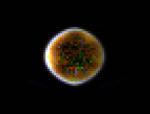 Gamma Ray Earth
31.03.2005
The pixelated planet above is actually our own planet Earth seen in gamma rays - the most energetic form of light. In fact, the gamma rays used to construct this view pack over 35 million electron volts (MeV) compared to a mere two electron volts (eV) for a typical visible light photon.
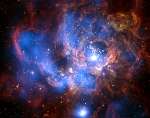 NGC 604: X rays from a Giant Stellar Nursery
5.02.2009
Some 3 million light-years distant in nearby spiral galaxy M33, giant stellar nursery NGC 604 is about 1,300 light-years across, or nearly 100 times the size of the Orion Nebula. In fact, among...
|
January February March April May June July August September October |
|||||||||||||||||||||||||||||||||||||||||||||||||