
|
You entered: light
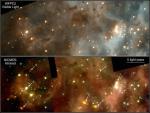 New Stars In 30 Doradus
1.10.1999
Compare these matched Hubble Space Telescope views (visible-light on top; infrared on bottom) of a region in the star-forming 30 Doradus Nebula. Find the numbered arrows in the infrared image which identify newborn massive stars. For example, arrows 1 and 5 both point to compact clusters of bright young stars.
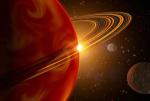 Saturn-Sized Worlds Discovered
30.03.2000
The last decade saw the profound discovery of many worlds beyond our solar system, but none analogs of our home planet Earth. Exploiting precise observational techniques, astronomers inferred the presence of well over two dozen extrasolar planets, most nearly as massive as gas giant Jupiter or more, in close orbits around sun-like stars.
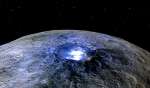 The Brightest Spot on Ceres
11.12.2015
Dwarf planet Ceres is the largest object in the Solar System's main asteroid belt with a diameter of about 950 kilometers. Exploring Ceres from orbit since March, the Dawn spacecraft's camera...
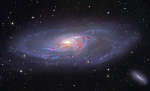 Messier 106
9.04.2021
Close to the Great Bear (Ursa Major) and surrounded by the stars of the Hunting Dogs (Canes Venatici), this celestial wonder was discovered in 1781 by the metric French astronomer Pierre Mechain. Later, it was added to the catalog of his friend and colleague Charles Messier as M106.
 Zeta Oph: Runaway Star
4.01.2024
Like a ship plowing through cosmic seas, runaway star Zeta Ophiuchi produces the arcing interstellar bow wave or bow shock seen in this stunning infrared portrait. In the false-color view, bluish Zeta...
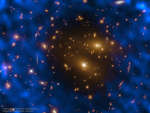 Galaxy Cluster Gas Creates Hole in Microwave Background
10.04.2017
Why would this cluster of galaxy punch a hole in the cosmic microwave background (CMB)? First, the famous CMB was created by cooling gas in the early universe and flies right through most gas and dust in the universe. It is all around us.
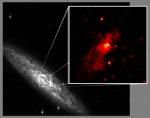 NGC 253: X Ray Zoom
7.06.2001
Astronomers now report that Chandra X-ray Observatory observations of galaxies known to be frantically forming stars show that these galaxies also contain luminous x-ray sources -- thought to be intermediate mass black holes and immense clouds of superheated gas. Take the lovely island universe NGC 253 for example.
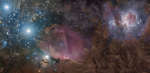 Orion in Gas, Dust, and Stars
29.09.2009
The constellation of Orion holds much more than three stars in a row. A deep exposure shows everything from dark nebula to star clusters, all imbedded in an extended patch of gaseous wisps in the greater Orion Molecular Cloud Complex.
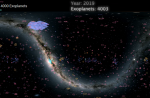 4000 Exoplanets
10.07.2019
Over 4000 planets are now known to exist outside our Solar System. Known as exoplanets, this milestone was passed last month, as recorded by NASA's Exoplanet Archive. The featured video highlights these exoplanets in sound and light, starting chronologically from the first confirmed detection in 1992.
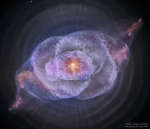 The Cats Eye Nebula in Optical and X-ray
7.11.2021
To some it looks like a cat's eye. To others, perhaps like a giant cosmic conch shell. It is actually one of brightest and most highly detailed planetary nebula known, composed of gas expelled in the brief yet glorious phase near the end of life of a Sun-like star.
|
January February March April May June July August September October |
|||||||||||||||||||||||||||||||||||||||||||||||||