
|
You entered: light
 38 Hours in the M81 Group
10.04.2025
From a garden on planet Earth, 38 hours of exposure with a camera and small telescope produced this cosmic photo of the M81 galaxy group. In fact, the group's dominant galaxy M81 is near the center of the frame sporting grand spiral arms and a bright yellow core.
 Young Star Cluster NGC 346
2.05.2025
The most massive young star cluster in the Small Magellanic Cloud is NGC 346, embedded in our small satellite galaxy's largest star forming region some 210,000 light-years distant. Of course the massive stars of NGC 346 are short lived, but very energetic.
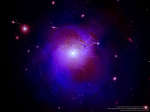 Unexpected X Rays from Perseus Galaxy Cluster
2.01.2018
Why does the Perseus galaxy cluster shine so strangely in one specific color of X-rays? No one is sure, but a much-debated hypothesis holds that these X-rays are a clue to the long-sought identity of dark matter.
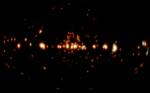 A Mystery in Gamma Rays
24.03.2000
Gamma rays are the most energetic form of light, packing a million or more times the energy of visible light photons. What if you could see gamma rays? If you could, the familiar skyscape...
 The Dark River to Antares
16.05.2020
A dark river seems to flow through this sky from the horizon toward colorful clouds near red giant star Antares. Murky looking, the dark river is a dusty nebula obscuring background starlight near the central Milky Way, although the dark dust nebula contains mostly hydrogen molecular gas.
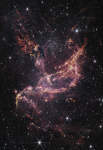 Young Star Cluster NGC 346
13.01.2023
The most massive young star cluster in the Small Magellanic Cloud is NGC 346, embedded in our small satellite galaxy's largest star forming region some 210,000 light-years distant. Of course the massive stars of NGC 346 are short lived, but very energetic.
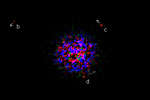 HR 8799: Discovery of a Multi planet Star System
17.11.2008
How common are planetary systems like our own Solar System? In the twelve years previous to 2008, over 300 candidate planetary systems have been found orbiting nearby stars. None, however, were directly imaged, few showed evidence for multiple planets, and many had a Jupiter-sized planet orbiting inside the orbit of Mercury.
 The Snake Nebula in Ophiuchus
11.08.1996
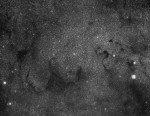
What slithers there? The dark curly lanes visible in part of the constellation Ophiuchus belong to the Snake Nebula. The Snake Nebula is a series of dark absorption clouds. Interstellar dust grains - composed predominantly of carbon - absorb visible starlight and reradiate much of it in the infrared.
 Distant Galaxies
22.06.1997
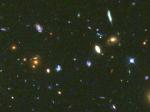
This Hubble Space Telescope image of a group of faint galaxies "far, far away" is a snap shot of the Universe when it was young. The bluish, irregularly shaped galaxies revealed in the image are up to eight billion light years away and seem to have commonly undergone galaxy collisions and bursts of star formation.
 Abell 370: Galaxy Cluster Gravitational Lens
28.08.2016
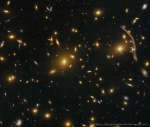
What is that strange arc? While imaging the cluster of galaxies Abell 370, astronomers had noted an unusual arc to the right of many cluster galaxies. Although curious, one initial response was to avoid commenting on the arc because nothing like it had ever been noted before.
|
January February March April May June July August September October |
|||||||||||||||||||||||||||||||||||||||||||||||||