
|
You entered: star
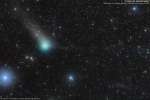 Comet PanSTARRS in the Southern Fish
16.06.2016
Now approaching our fair planet this Comet PanSTARRS (C/2013 X1) will come closest on June 21-22, a mere 5.3 light-minutes away. By then its appearance low in northern hemisphere predawn skies (high in the south), will be affected by the light of a nearly Full Moon, though.
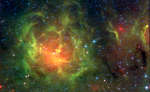 Spitzer s Trifid
12.02.2020
The Trifid Nebula, also known as Messier 20, is easy to find with a small telescope. About 30 light-years across and 5,500 light-years distant it's a popular stop for cosmic tourists in the nebula rich constellation Sagittarius.
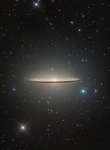 M104: The Sombrero Galaxy
13.05.2021
A gorgeous spiral galaxy, M104 is famous for its nearly edge-on profile featuring a broad ring of obscuring dust lanes. Seen in silhouette against an extensive central bulge of stars, the swath of cosmic dust lends a broad brimmed hat-like appearance to the galaxy suggesting a more popular moniker, the Sombrero Galaxy.
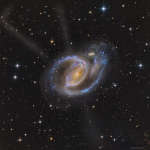 In the Arms of NGC 1097
15.11.2022
Spiral galaxy NGC 1097 shines in southern skies, about 45 million light-years away in the heated constellation Fornax. Its blue spiral arms are mottled with pinkish star forming regions in this colorful galaxy portrait.
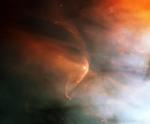 LL Orionis: When Cosmic Winds Collide
12.03.2002
This arcing, graceful structure is actually a bow shock about half a light-year across, created as the wind from young star LL Orionis collides with the Orion Nebula flow. Adrift in Orion's stellar...
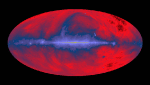 The Radio Sky: Tuned to 408MHz
13.12.1997
Tune your radio telescope to 408MHz (408 million cycles per second) and check out the Radio Sky! You should find that frequency on your dial somewhere between US broadcast television channels 13 and 14.
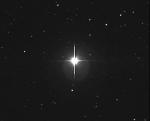 Introducing Nova Velorum 1999
24.05.1999
A bright nova was discovered Saturday that is currently visible to the unaided eye in southern skies. Nova Velorum 1999 was recorded near visual magnitude 3 independently by discoverers Peter Williams and Alan C. Gilmore (Mt. John U. Obs.), making it more luminous than many famous bright stars.
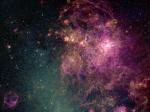 30 Doradus: The Tarantula Zone
11.12.2005
The Tarantula Nebula is more than 1,000 light-years across - a giant emission nebula within our neighboring galaxy the Large Magellanic Cloud. Inside this cosmic arachnid lies a central young cluster of massivestars, cataloged as R136, whose intense radiation and strong winds have helped energize the nebular glow and shape the spidery filaments.
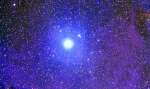 Polaris Dust Nebula
10.01.2008
Centered on North Star Polaris, this 4 degree wide field of view covers part of a complex of relatively unfamiliar, diffuse dust clouds soaring high above the plane of our Milky Way Galaxy.
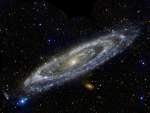 GALEX: The Andromeda Galaxy
18.05.2012
A mere 2.5 million light-years away, the Andromeda Galaxy really is just next door as large galaxy's go. So close, and spanning some 260,000 light-years, it took 11 different image fields from the Galaxy Evolution Explorer (GALEX) satellite's telescope to produce this gorgeous portrait of the spiral galaxy in ultraviolet light.
|
January February March April May June July August September October |
|||||||||||||||||||||||||||||||||||||||||||||||||