
|
You entered: star
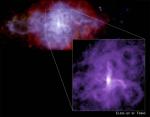 3C58: Pulsar Power
22.12.2004
Light from a star that exploded some ten thousand light-years away first reached our fair planet in the year 1181. Now known as supernova remnant 3C58, the region seen in this false-color image glows in x-rays, powered by a rapidly spinning neutron star or pulsar - the dense remains of the collapsed stellar core.
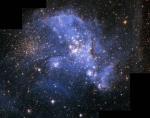 NGC 346 in the Small Magellanic Cloud
17.01.2005
A satellite galaxy of the Milky Way, the Small Magellanic Cloud (SMC) is a wonder of the southern sky, a mere 210,000 light-years distant in the constellation Tucana. Found among the SMC's clusters and nebulae NGC 346 is a star forming region about 200 light-years across, pictured above by the Hubble Space Telescope.
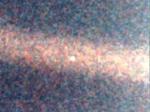 APOD: 2006 January 1- The Largest Rock in the Solar System
31.12.2005
There, that faint dot in the center - that's the largest rock known in our Solar System. It is larger than every known asteroid, moon, and comet nucleus. It is larger than any other local rocky planet.
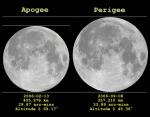 Apogee Moon, Perigee Moon
25.10.2007
Tonight, those blessed with clear skies can enjoy a glorious Full Moon, (exact full phase at 0452 UT, October 26). In fact, the Moon will reach its full phase within a few hours of perigee, the closest point in its elliptical orbit, making it the largest Full Moon of 2007.
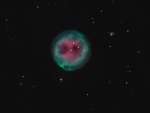 M97: The Owl Nebula
15.05.2009
The Owl Nebula is perched in the sky about 2,600 light-years away toward the bottom of the Big Dipper's bowl. Also cataloged as M97, the 97th object in Messier's well-known list, its round shape along with the placement of two large, dark "eyes" do suggest the face of a staring owl.
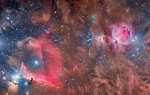 Horsehead and Orion Nebulas
29.10.2013
The dark Horsehead Nebula and the glowing Orion Nebula are contrasting cosmic vistas. Adrift 1,500 light-years away in one of the night sky's most recognizable constellations, they appear in opposite corners of the above stunning mosaic.
 Milky Way with Airglow Australis
3.09.2015
After sunset on September 1, an exceptionally intense, reddish airglow flooded this Chilean winter night skyscape. Above a sea of clouds and flanking the celestial Milky Way, the airglow seems to ripple and flow across the northern horizon in atmospheric waves.
 Wisps Surrounding the Horsehead Nebula
2.04.2019
The famous Horsehead Nebula in Orion is not alone. A deep exposure shows that the dark familiar shaped indentation, visible just below center, is part of a vast complex of absorbing dust and glowing gas.
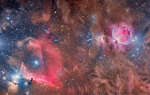 Horsehead and Orion Nebulas
8.05.2021
The dark Horsehead Nebula and the glowing Orion Nebula are contrasting cosmic vistas. Adrift 1,500 light-years away in one of the night sky's most recognizable constellations, they appear in opposite corners of the above stunning mosaic.
 APOD: 2025 September 8 Б IRAS 04302: Butterfly Disk Planet Formation
7.09.2025
This butterfly can hatch planets. The nebula fanning out from the star IRAS 04302+2247 may look like the wings of a butterfly, while the vertical brown stripe down the center may look like the butterfly's body -- but together they indicate an active planet-forming system.
|
January February March April May June July August September October |
|||||||||||||||||||||||||||||||||||||||||||||||||