
|
You entered: crater
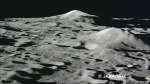 Kaguya Spacecraft Crashes into the Moon
29.06.2009
Japan's Kaguya spacecraft crashed into the Moon last week, as planned. Officially named the Selenological and Engineering Explorer (SELENE), the spacecraft was given the nickname Kaguya after the princess in the Japanese folklore story The Tale of the Bamboo Cutter.
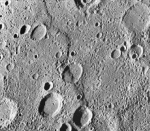 Mercury's Faults
21.01.1996
The surface of the planet Mercury is not without fault. In this case, however, "fault" refers to unusual surface features that are the topic of much speculation. The above fault line is called Santa Maria Rupes, and runs through many prominent craters.
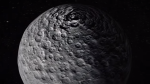 Fly Over Dwarf Planet Ceres
10.06.2015
What would it look like to fly over dwarf planet Ceres? Animators from the German Aerospace Center recently took actual images and height data from NASA's robotic Dawn mission -- currently visiting Ceres -- to generate several fascinating virtual sequences.
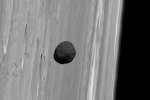 Martian Moon Phobos from Mars Express
1.12.2010
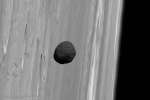
Why is Phobos so dark? Phobos, the largest and innermost of two Martian moons, is the darkest moon in the entire Solar System. Its unusual orbit and color indicate that it may be a captured asteroid composed of a mixture of ice and dark rock.
 Martian Moon Phobos from Mars Express
8.11.2020
Why is Phobos so dark? Phobos, the largest and innermost of two Martian moons, is the darkest moon in the entire Solar System. Its unusual orbit and color indicate that it may be a captured asteroid composed of a mixture of ice and dark rock.
 Pluto from above Cthulhu Regio
14.09.2015
New high resolution images of Pluto are starting to arrive from the outer Solar System. The robotic New Horizons spacecraft, which zoomed by Pluto in July, has finished sending back some needed engineering data and is now transmitting selections from its tremendous storehouse of images of Pluto and its moons.
 A Laguna Triangle
18.05.1999
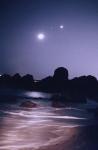
High above Laguna Beach last month hung bright celestial orbs. Visible after the California sunset were, from left to right, the Moon, Saturn, and Venus. Tonight and for the next few days, Venus and the Moon will again be visible together. Nearby stars will include Pollux, Castor, and Procyon.
 560 Kilometers Above Europa
3.03.1998
This is the closest photograph ever taken of Europa. Last December, NASA's spacecraft Galileo swept past the Jovian moon and took photographs which were released yesterday. Speculation that life-bearing oceans exist beneath Europa's surface caused NASA to put Galileo on orbits that approach Europa.
 The Hills of Ganymede
23.12.1996
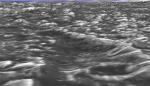
This computer generated 3D close-up view of Jupiter's large moon Ganymede was created using image data from NASA's Galileo spacecraft. Simulating stereo vision by combining two recent images recorded from different angles, 3 dimensional information was reconstructed for a section of Ganymede's surface.
 Europa: Ancient Water World
5.09.1995
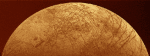
Beneath the cold icy surface of Jupiter's moon Europa are probably the only oceans of water in our Solar System outside of Earth. These oceans, possibly 50 kilometers deep, might also be the most likely local place to find extra-terrestrial life.
|
January February March April May June July August September October |
|||||||||||||||||||||||||||||||||||||||||||||||||