
|
You entered: crater
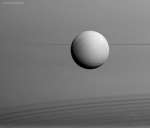 Dione, Rings, Shadows, Saturn
24.08.2015
What's happening in this strange juxtaposition of moon and planet? First and foremost, Saturn's moon Dione was captured here in a dramatic panorama by the robotic Cassini spacecraft currently orbiting the giant planet. The bright and cratered moon itself spans about 1100-km, with the large multi-ringed crater Evander visible on the lower right.
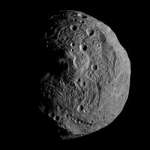 Virtual Flight over Asteroid Vesta
30.06.2019
What would it be like to fly over the asteroid Vesta? Animators from the German Aerospace Center took actual images and height data from NASA's Dawn mission when it visited asteroid Vesta a few years ago and generated a virtual movie.
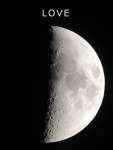 Lunar LOVE
3.11.2018
A more creative search by a group of amateur astronomers in the Ehime Prefecture of Shikoku Island, Japan has found lunar L-O-V-E. Their secret was an examination of this sharp image of the First Quarter Moon.
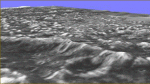 A Flyby View of Ganymede
25.10.1996
This is what it would look like to fly over the surface of Jupiter's moon Ganymede. NASA's robot spacecraft Galileo recently approached only 6000 miles from this frozen ice-ball of a moon. The above image is a digital reconstruction from two images taken during this flyby.
 Callisto: Dark Smashed Iceball
6.09.1995
Callisto is a dirty battered world, showing the most beaten surface of Jupiter's major moons. Made of a rocky core covered by fractured ice, Callisto's past collisions with large meteors are evident as large craters surrounded by concentric rings.
 APOD: 2023 July 31 Б Phobos over Mars
31.07.2023
Why is Phobos so dark? Phobos, the largest and innermost of the two Martian moons, is the darkest moon in the entire Solar System. Its unusual orbit and color indicate that it may be a captured asteroid composed of a mixture of ice and dark rock.
 Surveyor Slides
9.11.1997
"Safe!" In September 1967 (during regular season play), the Surveyor 5 lander actually slid several feet while making a successful soft landing on the Moon's Mare Tranquillitatis. Equipped with television cameras and soil...
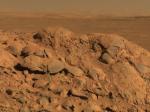 Looking Out Over Mars
23.08.2004
What would it be like to climb a hill and look out over Mars? That opportunity was afforded the Spirit rover earlier this month as it rolled to a high perch in the Columbia Hills.
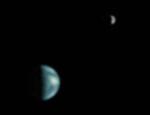 The Earth and Moon from Mars
26.05.2003
What does Earth look like from Mars? The first image of Earth from the red planet was captured earlier this month by the camera onboard the Mars Global Surveyor spacecraft currently orbiting Mars. Features visible on Earth include the Pacific Ocean, clouds, much of South America, and part of North America.
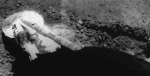 Surveyor Slides
20.10.1996
"Safe!" -- In September 1967 (during regular season play), while making a successful soft landing on the Moon's Mare Tranquillitatis, the Surveyor 5 lander actually slid several feet. Equipped with television cameras and some...
|
January February March April May June July August September October |
|||||||||||||||||||||||||||||||||||||||||||||||||