
|
You entered: planet
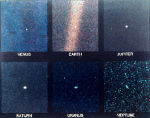 Our Solar System from Voyager
19.08.1995
After taking its spectacular pictures of the outer solar system planets, Voyager 1 looked back at six planets from the inner solar system. Here Venus, Earth, Jupiter, Saturn, Uranus, and Neptune, were all visible across the sky.
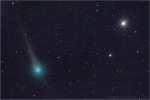 Lulin and Saturn near Opposition
27.02.2009
Tracking through the constellation Leo on February 23rd, bright planet Saturn and Comet Lulin were both near opposition -- opposite the Sun in planet Earth's sky. They also passed within only 2 degrees of each other creating a dramatic celestial photo-op.
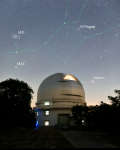 APOD: 2025 October 10 Б 50 Light-years to 51 Pegasi
10.10.2025
It's only 50 light-years to 51 Pegasi. That star's position is indicated in this snapshot from August 2025, taken on a night with mostly brighter stars visible above the dome at Observatoire de Haute-Provence in France.
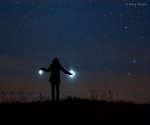 APOD: 2023 March 6 Б Jupiter and Venus from Earth
6.03.2023
It was visible around the world. The sunset conjunction of Jupiter and Venus in 2012 was visible almost no matter where you lived on Earth. Anyone on the planet with a clear western horizon at sunset could see them.
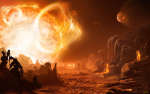 A Dangerous Sunrise on Gliese 876d
29.04.2012
On planet Gliese 876d, sunrises might be dangerous. Although nobody really knows what conditions are like on this close-in planet orbiting variable red dwarf star Gliese 876, the above artistic illustration gives one impression.
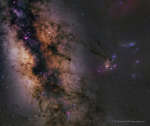 Saturn in the Milky Way
10.06.2017
Saturn is near opposition in planet Earth's sky. Rising at sunset and shining brightly throughout the night, it also lies near a line-of-sight to crowded starfields, nebulae, and obscuring dust clouds along the Milky Way.
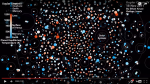 Kepler Orrery IV
5.12.2015
The exoplanet hunting Kepler mission's total for candidate and confirmed multiple planet systems stands at 1,705 worlds in orbit around 685 distant stars. Put all of those exoplanet orbits on the same scale and follow their relative orbital motions to get Kepler Orrery IV.
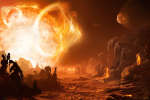 A Dangerous Sunrise on Gliese 876d
21.05.2008
On planet Gliese 876d, sunrises might be dangerous. Although nobody really knows what conditions are like on this close-in planet orbiting variable red dwarf star Gliese 876, the above artistic illustration gives one impression.
 A Conjunction of Crescents
8.02.2025
A waxing crescent Moon and a waning crescent Venus are found at opposite corners of this twilight telephoto field of view. The close conjunction of the two brightest celestial beacons in planet Earth's western evening sky was captured on February 1 from Rosario, Argentina.
 APOD: 2025 August 23 Б Fishing for the Moon
23.08.2025
How big is planet Earth's Moon? Compared to other moons of the Solar System, it's number 5 on the largest to smallest ranked list, following Jupiter's moon Ganymede, Saturn's moon Titan, and Jovian moons Callisto and Io. Continuing the list, the Moon comes before Jupiter's Europa and Neptune's Triton.
|
January February March April May June July August September October |
|||||||||||||||||||||||||||||||||||||||||||||||||