
|
You entered: planet
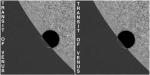 Transit of Venus Stereogram
17.07.2004
Venus glides in front of an enormous solar disk in these two frames from the TRACE satellite imaging of the inner planet's 2004 transit. Arranged in a "right/left" stereogram, the frames are intended...
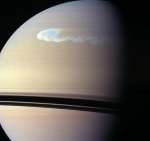 Saturn Storm
19.01.2011
Late last year, a new, remarkably bright storm erupted in Saturn's northern hemisphere. Amateur astronomers first spotted it in early December, with the ringed gas giant rising in planet Earth's predawn sky.
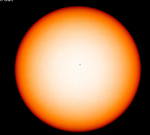 Mercury Crosses a Quiet Sun
2.12.2019
What's that black dot crossing the Sun? The planet Mercury. Mercury usually passes over or under the Sun, as seen from Earth, but last month the Solar System's innermost planet appeared to go just about straight across the middle.
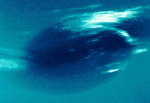 Neptune's Great Dark Spot: Gone But Not Forgotten
8.05.1996
When NASA's Voyager 2 spacecraft flew by distant Neptune in August of 1989, astronomers were shocked. Since Neptune receives only 3 percent the sunlight Jupiter does, they expected to find a dormant, dark, frigid planet. Instead, the Voyager images revealed evidence of a dynamic and turbulent world.
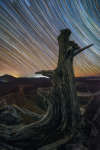 Lines of Time
7.12.2019
In time stars trace lines through the night sky on a rotating planet. Taken over two hours or more, these digitally added consecutive exposures were made with a camera and wide angle lens fixed to a tripod near Orel farm, Primorsky Krai, Russia, planet Earth.
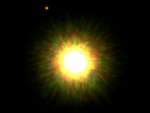 Companion of a Young Sun like Star
19.09.2008
Located just 500 light-years away toward the constellation Scorpius, this star is only slightly less massive and a little cooler than the Sun. But it is much younger, a few million years old compared to the middle-aged Sun's 5 billion years.
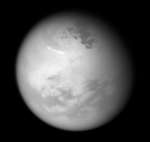 Northern Summer on Titan
20.06.2020
Today's solstice brings summer to planet Earth's northern hemisphere. But the northern summer solstice arrived for ringed planet Saturn over three years ago on May 24, 2017. Orbiting the gas giant, Saturn's moon Titan experiences the Saturnian seasons.
 APOD: 2025 September 6 Б Sardinia Sunset
6.09.2025
When the sun sets on September 7, the Full Moon will rise. And on that date denizens around much of our fair planet, including parts of Antarctica, Australia, Asia, Europe, and Africa can witness a total lunar eclipse, with the Moon completely immersed in Earth's shadow.
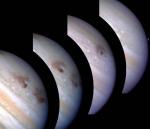 Jupiter Swallows Comet Shoemaker Levy 9
5.11.2000
What happens when a comet encounters a planet? If the planet has a rocky surface, a huge impact feature will form. A giant planet like Jupiter, however, is mostly gas. When Comet Shoemaker-Levy 9 struck Jupiter in 1994, each piece was swallowed into the vast Jovian atmosphere.
 A Solar System Portrait
5.05.1999
As the Voyager 1 spacecraft headed out of our Solar System, it looked back and took a parting family portrait of the Sun and planets. From beyond Pluto, our Solar System looks like a bright star surrounded by faint dots. In the above picture, the Sun is so bright it is blocked out for contrast.
|
January February March April May June July August September October |
|||||||||||||||||||||||||||||||||||||||||||||||||