
|
You entered: star cluster
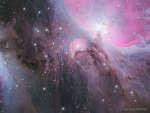 M43: Streams of Orion
6.10.2021
Where do the dark streams of dust in the Orion Nebula originate? This part of the Orion Molecular Cloud Complex, M43, is the often imaged but rarely mentioned neighbor of the more famous M42. M42, seen in part to the upper right, includes many bright stars from the Trapezium star cluster.
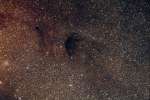 Dim World, Dark Nebula
8.07.2010
Dim, distant, dwarf planet Pluto can be hard to spot, especially in recent months as it wanders through the crowded starfields of Sagittarius and the central Milky Way. But fortunately for backyard Pluto hunters, it crossed in front of a dark nebula in early July.
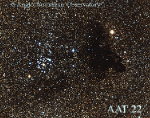 Bright Stars and Dark Clouds
25.09.1996
Did you ever feel like a black cloud was following you around? Well don't feel bad - this even happened to the bright young stars of the open cluster NGC 6520. On the left are the cluster's bright blue stars.
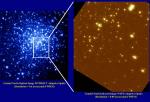 NGC 6934 from Gemini North
30.06.1999
What's going on near the center of globular cluster NGC 6934? The blur caused by the Earth's atmosphere has prevented astronomers from discerning individual stars in this unusual environment. Telescopes in space can help, but the new Gemini North telescope took the above picture from the ground.
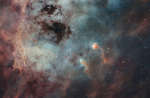 APOD: 2026 March 17 Б The Tadpoles of IC 410
17.03.2026
This telescopic close-up shows off the central regions of otherwise faint emission nebula IC 410, captured under backyard skies. Presented in a Hubble color palette, the image combines visible broadband and narrowband data with data from the near-infrared. Below and right of center are two remarkable inhabitants of the interstellar pond of gas and dust.
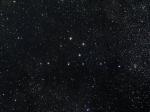 Collinder 399: The Coat Hanger
12.01.2007
Is this coat hanger a star cluster or an asterism? This cosmic hang-up has been debated over much of last century, as astronomers wondered whether this binocular-visible object is really a physically associated open cluster or a chance projection. Chance star projections are known as asterisms, an example of which is the popular Big Dipper.
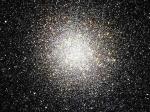 Globular Cluster M22 from CFHT
27.06.2005
The globular cluster M22, pictured above, contains over 100,000 stars. These stars formed together and are gravitationally bound. Stars orbit the center of the cluster, and the cluster orbits the center of our Galaxy. So far, about 140 globular clusters are known to exist in a roughly spherical halo around the Galactic center.
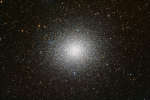 Omega Centauri: The Brightest Globular Cluster
1.05.2013
This huge ball of stars predates our Sun. Long before humankind evolved, before dinosaurs roamed, and even before our Earth existed, ancient globs of stars condensed and orbited a young Milky Way Galaxy. Of the 200 or so globular clusters that survive today, Omega Centauri is the largest, containing over ten million stars.
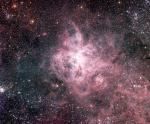 The Tarantula Zone
13.06.2002
The Tarantula Nebula is more than 1,000 light-years across - a giant emission nebula within our neighboring galaxy the Large Magellanic Cloud. Inside this cosmic arachnid lies a central young cluster of massive stars, cataloged as R136, whose intense radiation and strong winds have helped energize the nebular glow and shape the spidery filaments.
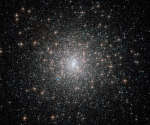 Globular Cluster M15 from Hubble
3.05.2011
Stars, like bees, swarm around the center of bright globular cluster M15. This ball of over 100,000 stars is a relic from the early years of our Galaxy, and continues to orbit the Milky Way's center.
|
January February March April May June July August September October |
|||||||||||||||||||||||||||||||||||||||||||||||||