
|
You entered: NASA
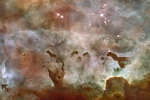 Dark Clouds of the Carina Nebula
28.05.2008
What dark forms lurk in the mists of the Carina Nebula? These ominous figures are actually molecular clouds, knots of molecular gas and dust so thick they have become opaque. In comparison, however, these clouds are typically much less dense than Earth's atmosphere.
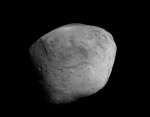 Comet Tempel 1 from Stardust NeXT Spacecraft
16.02.2011
No comet has ever been visited twice before. Therefore, the unprecedented pass of the Stardust-NeXT spacecraft near Comet Tempel 1 earlier this week gave humanity a unique opportunity to see how the nucleus of a comet changes over time.
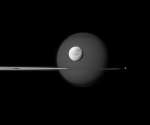 In Through and Beyond Saturns Rings
26.10.2011
A fourth moon is visible on the above image if you look hard enough. First -- and furthest in the background -- is Titan, the largest moon of Saturn and one of the larger moons in the Solar System. The dark feature across the top of this perpetually cloudy world is the north polar hood.
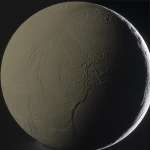 Enceladus Backlit by Saturn
8.02.2012
This moon is shining by the light of its planet. Specifically, a large portion of Enceladus pictured above is illuminated primarily by sunlight first reflected from the planet Saturn. The result is that the normally snow-white moon appears in the gold color of Saturn's cloud tops.
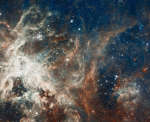 Star Formation in the Tarantula Nebula
16.05.2012
The largest, most violent star forming region known in the whole Local Group of galaxies lies in our neighboring galaxy the Large Magellanic Cloud (LMC). Were the Tarantula Nebula at the distance of the Orion Nebula -- a local star forming region -- it would take up fully half the sky.
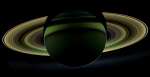 Saturn at Night
22.12.2012
Splendors seldom seen are revealed in this glorious picture from Saturn's shadow. Imaged by Cassini on October 17, 2012 during its 174th orbit, the ringed planet's night side is viewed from...
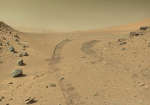 Crossing Dingo Gap on Mars
18.02.2014
An important threshold on Mars has now been crossed. Landing in mid-2012, the Curiosity rover is searching for clues of whether life could ever have existed on the red planet. Recent findings of Curiosity include evidence for an ancient (but now dried) freshwater lake, and the non-detection of the biomarker methane in the Martian atmosphere.
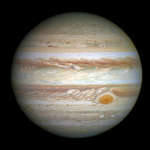 Hubble s Jupiter and Shrinking Great Red Spot
17.05.2014
Gas giant Jupiter is the solar system's largest world with about 320 times the mass of planet Earth. It's also known for a giant swirling storm system, the Great Red Spot, featured in this sharp Hubble image from April 21.
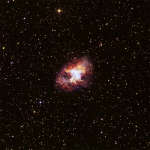 Cosmic Crab Nebula
25.07.2014
The Crab Pulsar, a city-sized, magnetized neutron star spinning 30 times a second, lies at the center of this tantalizing wide-field image of the Crab Nebula. A spectacular picture of one of our Milky Way's supernova remnants, it combines optical survey data with X-ray data from the orbiting Chandra Observatory.
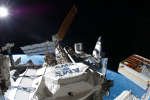 Space Station Detector Finds Unexplained Positron Excess
6.10.2014
Where did all these high energy positrons come from? The Alpha Magnetic Spectrometer (AMS-02) onboard the International Space Station (ISS) has been meticulously recording how often it is struck by both high energy electrons and positrons since 2011.
|
January February March April May June July August September October |
|||||||||||||||||||||||||||||||||||||||||||||||||