
|
You entered: NASA
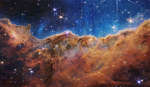 Carina Cliffs from the Webb Space Telescope
5.09.2022
Stars created these cliffs. Specifically, the destructive winds and energetic light from the stars in the open cluster NGC 3324 eroded away part of a mountain of dark interstellar dust in the northern part of the Carina Nebula.
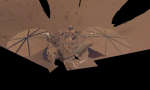 InSight's Final Selfie
4.11.2022
The Mars InSight lander returned its first image from the Red Planet's flat, equatorial Elysium Planitia after a successful touchdown on November 26, 2018. The history making mission to explore the martian Interior using Seismic investigations, geodesy, and heat transport has been operating for over 1,400 martian days or sols.
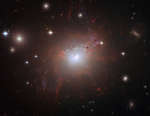 Active Galaxy NGC 1275
26.01.2023
Active galaxy NGC 1275 is the central, dominant member of the large and relatively nearby Perseus Cluster of Galaxies. Wild-looking at visible wavelengths, the active galaxy is also a prodigious source of x-rays and radio emission.
 Pandora s Cluster of Galaxies
9.06.2023
This deep field mosaicked image presents a stunning view of galaxy cluster Abell 2744 from the James Webb Space Telescope's NIRCam. Also dubbed Pandora's Cluster, Abell 2744 itself appears to be a ponderous merger of three different massive galaxy clusters some 3.5 billion light-years away toward the constellation Sculptor.
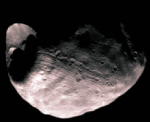 Phobos: Doomed Moon of Mars
31.05.1998
Phobos is doomed. Mars, the red planet named for the Roman god of war, has two tiny moons, Phobos and Deimos, whose names are derived from the Greek for Fear and Panic. These Martian...
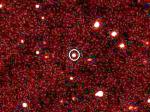 Solar System Object Larger than Pluto Discovered
31.07.2005
Is that a tenth planet? A faint, slowly moving dot discovered by computer shows clear signs of being a deep Solar System object at least as large as Pluto. The object, designated 2003 UB 313 , is currently situated nearly 100 times the Earth-Sun distance -- over twice the average Pluto-Sun distance.
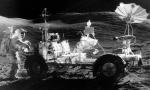 Apollo 17's Lunar Rover
1.07.1999
In December of 1972, Apollo 17 astronauts Eugene Cernan and Harrison Schmitt spent about 75 hours exploring the Moon's Taurus-Littrow valley while colleague Ronald Evans orbited overhead. Cernan and Schmitt were the last humans to walk or ride on the Moon - aided in their explorations by a Lunar Roving Vehicle.
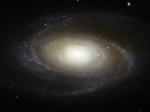 Bright Spiral Galaxy M81 from Hubble
29.05.2007
The Hubble Space Telescope has resolved individual stars in a spectacular new image of nearby spiral galaxy M81. The feat is similar to Edwin Hubble's historic images with the Mt. Wilson 100-inch Hooker Telescope in the 1920s that resolved stars in neighboring galaxy M31.
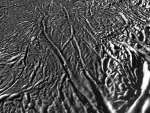 Close Up of Enceladus Tiger Stripes
31.03.2008
Could life exist beneath Enceladus? A recent flyby of Saturn's icy moon has bolstered this fascinating idea. Two years ago, images from the robotic Cassini spacecraft orbiting Saturn led astronomers to the undeniable...
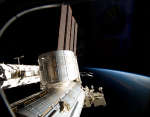 A Large Space Station Over Earth
14.04.2010
The International Space Station is the largest object ever constructed by humans in space. The station perimeter now extends over roughly the area of a football field, although only a small fraction of this is composed of modules habitable by humans.
|
January February March April May June July August September October |
|||||||||||||||||||||||||||||||||||||||||||||||||