
|
You entered: NASA
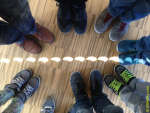 Solar Eclipse Shoes in the Classroom
8.03.2016
The total solar eclipse of March 8/9 will be the only total eclipse in 2016. The New Moon's dark shadow traces a limited, narrow path across planet Earth for viewing the total phase, making landfall in Indonesia and mostly tracking across the Pacific Ocean.
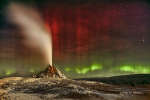 Aurora Over White Dome Geyser
2.10.2016
Sometimes both heaven and Earth erupt. Colorful aurorae erupted unexpectedly a few years ago, with green aurora appearing near the horizon and brilliant bands of red aurora blooming high overhead. A bright Moon lit the foreground of this picturesque scene, while familiar stars could be seen far in the distance.
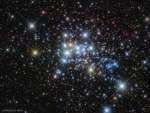 The Massive Stars in Westerlund 1
20.06.2017
Star cluster Westerlund 1 is home to some of the largest and most massive stars known. It is headlined by the star Westerlund 1-26, a red supergiant star so big that if placed in the center of our Solar System, it would extend out past the orbit of Jupiter.
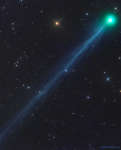 The Ion Tail of New Comet SWAN
29.04.2020
Newly discovered Comet SWAN has already developed an impressive tail. The comet came in from the outer Solar System and has just passed inside the orbit of the Earth. Officially designated C/2020 F8 (SWAN)...
 Pillars of Creation
20.10.2022
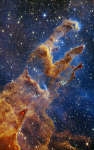
A now famous picture from the Hubble Space Telescope featured these star forming columns of cold gas and dust light-years long inside M16, the Eagle Nebula, dubbed the Pillars of Creation. This James Webb Space Telescope NIRCam image expands Hubble's exploration of that region in greater detail and depth inside the iconic stellar nursery.
 APOD: 2026 June 1 Б Saturn at Night
1.06.2026
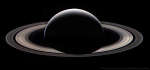
Telescopic views of Saturn and its beautiful rings often make it the star of star parties. But this stunning view of the outer gas gaint planet's rings and night side just isn't possible from telescopes in the vicinity of planet Earth.
 APOD: 2026 September 21 Б Cocoon Nebula Wide Field
21.09.2026
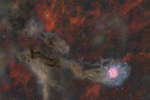
When does a nebula look like a comet? In this crowded starfield covering over two degrees within the high-flying constellation of the Swan (Cygnus), the eye is drawn to the Cocoon Nebula. A compact...
 Shells in the Egg Nebula
26.06.1999
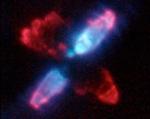
The Egg Nebula is taking a beating. Like a baby chick pecking its way out of an egg, the star in the center of the Egg Nebula is casting away shells of gas and dust as it slowly transforms itself into a white dwarf star.
 Driving to the Sun
27.07.1996
How long would it take to drive to the Sun? Brittany, age 7, and D.J., age 12, ponder this question over dinner one evening. James, also age 7, suggests taking a really fast racing car while Christopher, age 4, eagerly agrees.
 A Quasar Portrait Gallery
25.11.1996
QUASARs (QUASi-stellAR objects) lie near the edge of the observable Universe. Discovered in 1963, astronomers were astounded - to be visible at such extreme distances of billions of light-years they must emit prodigious amounts of energy. Where does the energy come from?
|
January February March April May June July August September October |
|||||||||||||||||||||||||||||||||||||||||||||||||