
|
You entered: NASA
 Huge Gamma Ray Bubbles Found Around Milky Way
10.11.2010
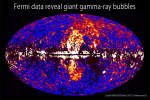
Did you know that our Milky Way Galaxy has huge bubbles emitting gamma rays from the direction of the galactic center? Neither did anybody. As the data from the Earth-orbiting Fermi satellite began acuminating over the past two years, however, a large and unusual feature toward our Galaxy's center became increasingly evident.
 Saturns Hexagon Comes to Light
22.01.2012
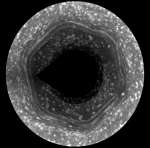
Believe it or not, this is the North Pole of Saturn. It is unclear how an unusual hexagonal cloud system that surrounds Saturn's north pole was created, keeps its shape, or how long it will last.
 A Hole in Mars
18.07.2012
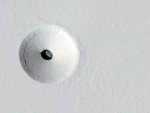
What created this unusual hole in Mars? The hole was discovered by chance on images of the dusty slopes of Mars' Pavonis Mons volcano taken by the HiRISE instrument aboard the robotic Mars Reconnaissance Orbiter currently circling Mars. The hole appears to be an opening to an underground cavern, partly illuminated on the image right.
 Plutos Newly Discovered Moons Receive Names
8.07.2013
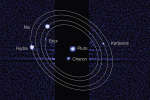
Pluto's newly discovered moons now have names. Known previously as P4 and P5, the International Astronomical Union has now given the fourth and fifth discovered moons of Pluto the names Kerberos and Styx.
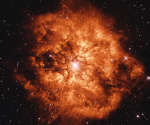 Wolf Rayet Star 124: Stellar Wind Machine
1.07.2014
Some stars explode in slow motion. Rare, massive Wolf-Rayet stars are so tumultuous and hot that they slowly disintegrating right before our telescopes. Glowing gas globs each typically over 30 times more massive than the Earth are being expelled by violent stellar winds.
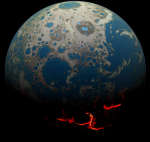 Four Billion BCE: Battered Earth
5.08.2014
No place on Earth was safe. Four billion years ago, during the Hadean eon, our Solar System was a dangerous shooting gallery of large and dangerous rocks and ice chunks. Recent examination of lunar...
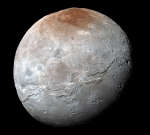 Charon: Moon of Pluto
2.10.2015
A darkened and mysterious north polar region informally known as Mordor Macula caps this premier high-resolution portrait of Charon, Pluto's largest moon. Captured by New Horizons near its closest approach on July 14, the image data was transmitted to Earth on September 21.
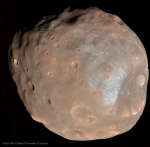 Phobos: Doomed Moon of Mars
22.11.2015
This moon is doomed. Mars, the red planet named for the Roman god of war, has two tiny moons, Phobos and Deimos, whose names are derived from the Greek for Fear and Panic. These...
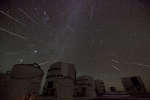 When Gemini Sends Stars to Paranal
13.12.2015
From a radiant point in the constellation of the Twins, the annual Geminid meteor shower rain down on planet Earth. Tonight, the Geminds reach their peak and could be quite spectacular. The featured blended image, however, captured the shower's impressive peak in the year 2012.
 Earthset from the Lunar Reconnaissance Orbiter
4.01.2016
On the Moon, the Earth never rises -- or sets. If you were to sit on the surface of the Moon, you would see the Earth just hang in the sky. This is because the Moon always keeps the same side toward the Earth.
|
January February March April May June July August September October |
|||||||||||||||||||||||||||||||||||||||||||||||||