
|
You entered: color
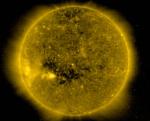 Hole in the Sun
27.09.2007
The dark expanse below the equator of the Sun is a coronal hole -- a low density region extending above the surface where the solar magnetic field opens freely into interplanetary space. Shown in false color, the picture was recorded on September 19th in extreme ultraviolet light by the EIT instrument onboard the space-based SOHO observatory.
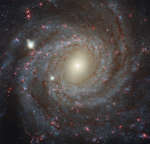 Facing NGC 3344
13.04.2018
From our vantage point in the Milky Way Galaxy, we see NGC 3344 face-on. Nearly 40,000 light-years across, the big, beautiful spiral galaxy is located just 20 million light-years away in the constellation of Leo Minor. This multi-color Hubble Space Telescope close-up of NGC 3344 includes remarkable details from near infrared to ultraviolet wavelengths.
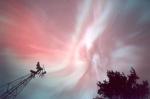 Red Auroral Corona
15.01.2002
Few auroras show this level of detail. This unusual display of an auroral corona occurred on Earth three days after an unusual solar event -- the fifth most powerful explosion yet recorded on the Sun. An X14-class solar flare on April 15 sent a tremendous Coronal Mass Ejection (CME) into the Solar System.
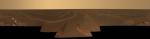 Desolate Mars: Rub al Khali
22.08.2005
Sometimes on Mars, there is nothing to see but red sand. Traveling two kilometers south of Endurance Crater, the robotic rover Opportunity now exploring Mars stopped and took a 360 degree panorama of a desolate and rusted Martian landscape.
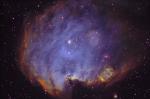 NGC 2174: Emission Nebula in Orion
8.12.2006
A lesser known sight in the nebula-rich constellation Orion, NGC 2174 can be found with binoculars near the head of the celestial hunter. About 6,400 light-years distant, the glowing cosmic cloud surrounds loose clusters of young stars.
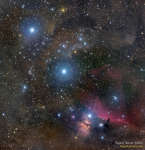 Alnitak, Alnilam, Mintaka
12.12.2013
Alnitak, Alnilam, and Mintaka, are the bright bluish stars from east to west (lower right to upper left) along the diagonal in this gorgeous cosmic vista. Otherwise known as the Belt of Orion, these three blue supergiant stars are hotter and much more massive than the Sun.
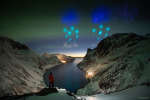 AZURE Vapor Tracers over Norway
8.04.2019
What's happening in the sky? The atmosphere over northern Norway appeared quite strange for about 30 minutes last Friday when colorful clouds, dots, and plumes suddenly appeared. The colors were actually created by the NASA-funded Auroral Zone Upwelling Rocket Experiment (AZURE) which dispersed gas tracers to probe winds in Earth's upper atmosphere.
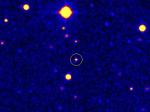 Mystery Object Explained
28.09.1999
Explorers often discover the unexpected. Such was the case when the Second Palomar Observatory Sky Survey chanced upon the unusual object circled in the above photograph. The so-called mystery object appeared star-like but displayed colors unlike most stars or quasars.
 APOD: 2025 June 18 Б Space Station Silhouette on the Moon
18.06.2025
What's that unusual spot on the Moon? It's the International Space Station. Using precise timing, the Earth-orbiting space platform was photographed in front of a partially lit gibbous Moon in 2019. The featured image was taken from Palo Alto, California, USA with an exposure time of only 1/667 of a second.
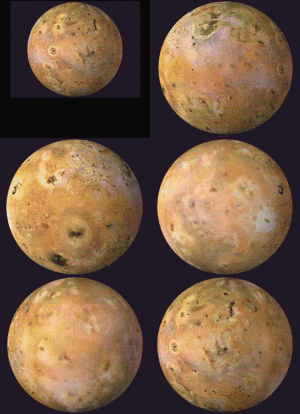 Io Rotating
24.10.2000
The surface of Io is continually changing. Jupiter's moon is the home to many powerful volcanoes so active they are effectively turning the moon inside out. The above time-lapse sequence is a composite of images taken during two space missions that approached the violent moon: Voyager and Galileo.
|
January February March April May June July August September October |
|||||||||||||||||||||||||||||||||||||||||||||||||