
|
You entered: color
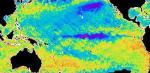 La Nina Watch
20.07.1998
Goodbye El Niño. Hello La Niña? Scientists are watching to see if an evolving pool of relatively cool water in the mid-Pacific Ocean will develop into a full "La Niña". Over the past several months, the water temperature in the Equatorial Pacific Ocean has been doing a flip-flop.
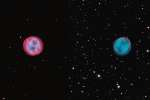 Northern and Southern Owls
6.05.2010
Captured in colorful telescopic portraits, two cosmic owls glare back toward planet Earth in this intriguing comparison of planetary nebulae. On the left is M97 in the constellation Ursa Major, also known in the northern hemisphere as the Owl Nebula.
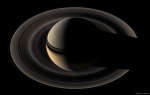 Crescent Saturn
7.07.2019
Saturn never shows a crescent phase -- from Earth. But when viewed from beyond, the majestic giant planet can show an unfamiliar diminutive sliver. This image of crescent Saturn in natural color was taken by the robotic Cassini spacecraft in 2007.
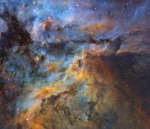 South of Carina
22.05.2020
With natal dust clouds in silhouette against glowing atomic gas, this colorful and chaotic vista lies within one of the largest star forming regions in the Milky Way galaxy, the Great Carina Nebula.
 APOD: 2025 March 4 Б A Quadruple Alignment over Italy
4.03.2025
Why does this Moon look so unusual? A key reason is its vivid red color. The color is caused by the deflection of blue light by Earth's atmosphere -- the same reason that the daytime sky appears blue. The Moon also appears unusually distorted.
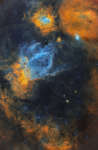 APOD: 2026 April 01 Б The Claw and Bubble Nebulae
1.04.2026
What unexpected things do you see when you look up at the night sky? TodayБs image resembles an abstract painting, with large swaths of color strewn across a cosmic canvas seemingly without design. Despite the image's abstract nature, the human mind finds patterns, identifying a large claw reaching up towards a floating bubble.
 The Dark River to Antares
16.05.2020
A dark river seems to flow through this sky from the horizon toward colorful clouds near red giant star Antares. Murky looking, the dark river is a dusty nebula obscuring background starlight near the central Milky Way, although the dark dust nebula contains mostly hydrogen molecular gas.
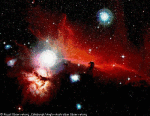 Orion's Horsehead Nebula
2.10.1996
The Horsehead Nebula is arguably the most famous nebula on the sky. It is visible as the black indentation to the red emission nebula seen just to the right of center of the above photograph. The bright star near the center is located in the belt of the familiar constellation of Orion.
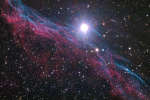 NGC 6960: The Witch s Broom Nebula
19.08.2008
Ten thousand years ago, before the dawn of recorded human history, a new light must suddenly have appeared in the night sky and faded after a few weeks. Today we know this light was an exploding star and record the colorful expanding cloud as the Veil Nebula.
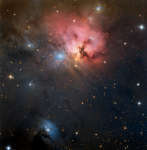 NGC 1579: Trifid of the North
9.03.2012
Colorful NGC 1579 resembles the better known Trifid Nebula, but lies much farther north in planet Earth's sky, in the heroic constellation Perseus. About 2,100 light-years away and 3 light-years across...
|
January February March April May June July August September October |
|||||||||||||||||||||||||||||||||||||||||||||||||