
|
You entered: color
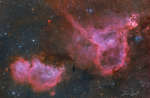 APOD: 2023 February 14 Б The Heart and Soul Nebulas
14.02.2023
Is the heart and soul of our Galaxy located in Cassiopeia? Possibly not, but that is where two bright emission nebulas nicknamed Heart and Soul can be found. The Heart Nebula, officially dubbed IC 1805 and visible in the featured image on the upper right, has a shape reminiscent of a classical heart symbol.
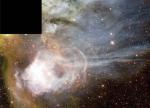 N44C: A Nebular Mystery
14.05.2002
Why is N44C glowing so strangely? The star that appears to powers the nebula, although young and bright, does not seem hot enough to create some of the colors observed. A search for a hidden hotter star in X-rays has come up empty.
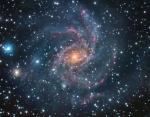 Facing NGC 6946
10.04.2004
From our vantage point in the Milky Way Galaxy, we see NGC 6946 face-on. The big beautiful spiral galaxy is located just 10 million light-years away, behind a veil of foreground stars in the high and far-off constellation of Cepheus.
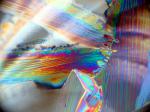 Frizion Illume
26.02.2005
Scientific images of cosmic dust clouds or even frozen water can be esthetic too. In fact, this picture of thin layers of forming ice crystals uses a scientific understanding of light's wave properties solely for artistic purposes. Titled "Illume", the picture was created by astrophysicist Peter Wasilewski.
 Blue Sun Bristling
4.11.2009
Our Sun may look like all soft and fluffy, but it's not. Our Sun is an extremely large ball of bubbling hot gas, mostly hydrogen gas. The above picture...
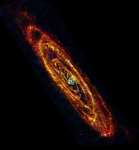 Herschel s Andromeda
2.02.2013
This infrared view from the Herschel Space Observatory explores the Andromeda Galaxy, the closest large spiral galaxy to our own Milky Way. Only 2.5 million light-years distant, the famous island universe is also known to astronomers as M31. Andromeda spans over 200,000 light-years making it more the twice the size of the Milky Way.
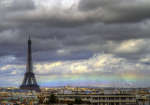 A Horizon Rainbow in Paris
27.03.2013
Why is this horizon so colorful? Because, opposite the Sun, it is raining. What is pictured above is actually just a common rainbow. It's uncommon appearance is caused by the Sun being unusually high in the sky during the rainbow's creation.
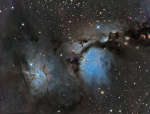 M78 and Reflecting Dust Clouds
26.03.2014
An eerie blue glow and ominous columns of dark dust highlight M78 and other bright reflection nebula in the constellation of Orion. The dark filamentary dust not only absorbs light, but also reflects the light of several bright blue stars that formed recently in the nebula.
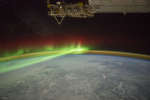 Aurora and Manicouagan Crater from the Space Station
29.05.2018
How many of these can you find in today's featured photograph: an aurora, airglow, one of the oldest impact craters on the Earth, snow and ice, stars, city lights, and part of the International Space Station? Most of these can be identified by their distinctive colors.
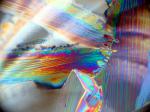 Frizion Illume
29.05.2003
Scientific images of cosmic dust clouds or even frozen water can be esthetic too. In fact, this picture of thin layers of forming ice crystals uses a scientific understanding of light's wave properties solely for artistic purposes. Titled "Illume", the picture was created by astrophysicist Peter Wasilewski.
|
January February March April May June July August September October |
|||||||||||||||||||||||||||||||||||||||||||||||||