
|
You entered: color
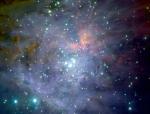 The Orion Nebula from VLT
30.01.2001
The Great Nebula in Orion is a colorful place. Visible to the unaided eye, it appears as a small fuzzy patch in the constellation of Orion. But this image, a representative-color composite...
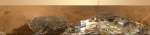 A Mars Panorama from the Phoenix Lander
13.03.2011
If you could stand on Mars, what would you see? The robotic Phoenix spacecraft that landed on Mars in 2008 recorded the above spectacular panorama. The above image is actually a digital combination of over 100 camera pointings and surveys fully 360 degrees around the busy robotic laboratory.
 The Belt of Venus Over Mercedes Argentina
7.02.2012
Although you've surely seen it, you might not have noticed it. During a cloudless twilight, just before sunrise or after sunset, part of the atmosphere above the horizon appears slightly off-color, slightly pink or orange.
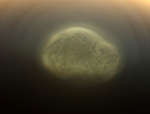 South Polar Vortex Discovered on Titan
24.07.2012
What's happening over the south pole of Titan? A vortex of haze appears to be forming, although no one is sure why. The above natural-color image shows the light-colored feature. The vortex was found on images taken last month when the robotic Cassini spacecraft flew by the unusual atmosphere-shrouded moon of Saturn.
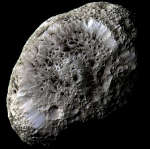 Saturns Hyperion: A Moon with Odd Craters
27.02.2011
What lies at the bottom of Hyperion's strange craters? Nobody's sure. To help find out, the robot Cassini spacecraft now orbiting Saturn swooped past the sponge-textured moon in 2005 and 2010 and took images of unprecedented detail.
 Soaring over Titan
23.11.2014
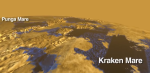
What would it look like to fly over Titan? Radar images from NASA's robotic Cassini satellite in orbit around Saturn have been digitally compiled to simulate such a flight. Cassini has swooped past Saturn's cloudiest moon several times since it arrived at the ringed planet in 2004.
 A Sagittarius Triplet
10.07.2024
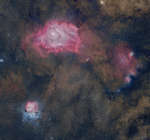
These three bright nebulae are often featured on telescopic tours of the constellation Sagittarius and the crowded starfields of the central Milky Way. In fact, 18th century cosmic tourist Charles Messier cataloged two of them; M8, the large nebula above center, and colorful M20 below and left in the frame.
 In the Heart of the Crab
5.06.2000
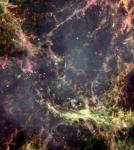
The supernova explosion that formed the Crab Nebula was first seen on the year 1054. Last week, astronomers released a new image of the still-evolving center of the explosion. The above representative-color photograph...
 Comet McNaught Hartley
14.03.2001
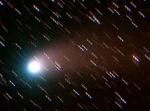
Outbound and climbing above the plane of our solar system, comet McNaught-Hartley (C/1999 T1) is presently soaring through northern skies. This telescopic picture, a composite of many 30 second exposures made through three color filters, recorded the delicate colors in its diminutive coma and faint tail on February 26th.
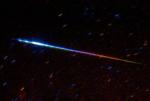 A Perseid Meteor
11.08.2002
The ongoing Perseid Meteor Shower should be at its strongest on August 12 and 13. The best time to watch will be between 2:00 AM and dawn on Monday morning (so plan on setting your alarm tonight!) and then again on Tuesday.
|
January February March April May June July August September October |
|||||||||||||||||||||||||||||||||||||||||||||||||