
|
You entered: spacecraft
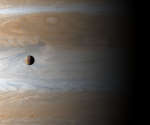 Io: Moon Over Jupiter
8.04.2012
How big is Jupiter's moon Io? The most volcanic body in the Solar System, Io (usually pronounced "EYE-oh") is 3,600 kilometers in diameter, about the size of planet Earth's single large natural satellite.
 Pluto from above Cthulhu Regio
14.09.2015
New high resolution images of Pluto are starting to arrive from the outer Solar System. The robotic New Horizons spacecraft, which zoomed by Pluto in July, has finished sending back some needed engineering data and is now transmitting selections from its tremendous storehouse of images of Pluto and its moons.
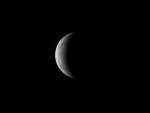 MESSENGER Approaches Mercury
16.01.2008
Two days ago, the MESSENGER spacecraft became only the second in human history to swoop past Mercury. The last spacecraft to visit the Sun's closest planet was Mariner 10 over 35 years ago. Mariner 10 was not able to photograph Mercury's entire surface, and the images it did send back raised many questions.
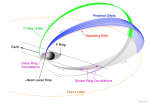 Cassinis Grand Finale Tour at Saturn
25.01.2017
Cassini is being prepared to dive into Saturn. The robotic spacecraft that has been orbiting and exploring Saturn for over a decade will end its mission in September with a spectacular atmospheric plunge. Pictured here is a diagram of Cassini's remaining orbits, each taking about one week.
 Orion and the Ocean of Storms
7.12.2023
On December 5, 2022, a camera on board the uncrewed Orion spacecraft captured this view as Orion approached its return powered flyby of the Moon. Beyond one of Orion's extended solar arrays lies dark, smooth, terrain along the western edge of the Oceanus Procellarum.
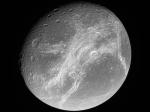 Bright Cliffs Across Saturns Moon Dione
5.09.2006
What causes the bright streaks on Dione? Recent images of this unusual moon by the robot Cassini spacecraft now orbiting Saturn are helping to crack the mystery. Close inspection of Dione's trailing hemisphere, pictured above, indicates that the white wisps are composed of deep ice cliffs dropping hundreds of meters.
 Mars Weather Watch
16.08.1999
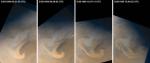
Mars may be a cold, dry planet but its weather is dynamic. On June 30, wide angle cameras on board the Mars Global Surveyor (MGS) spacecraft watched the development of this large scale storm system above Mars' north polar area.
 APOD: 2024 January 24 Б Earth and Moon from Beyond
24.01.2024
What do the Earth and Moon look like from beyond the Moon? Although frequently photographed together, the familiar duo was captured with this unusual perspective in late 2022 by the robotic Orion spacecraft of NASA's Artemis I mission as it looped around Earth's most massive satellite and looked back toward its home world.
 Mars Engulfed
17.10.2001
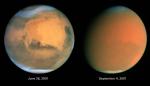
For months now, Mars has been engulfed by a great dust storm, the biggest seen raging across the Red Planet in decades. As a result, these two Hubble Space Telescope storm watch images from late June and early September offer dramatically contrasting views of the martian surface.
 Plutos Newly Discovered Moons Receive Names
8.07.2013
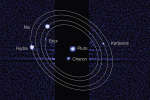
Pluto's newly discovered moons now have names. Known previously as P4 and P5, the International Astronomical Union has now given the fourth and fifth discovered moons of Pluto the names Kerberos and Styx.
|
January February March April May June July August September October |
|||||||||||||||||||||||||||||||||||||||||||||||||