
|
You entered: spacecraft
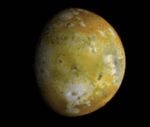 Galileo's First Color Image of Io
19.07.1996
Above is the first color image of Jupiter's volcanic moon Io released by the Galileo Project. (Io sounds like "eye-oh".) The image was made on June 25 when the Galileo spacecraft approached within 1.4 million miles.
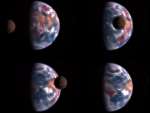 31 Million Miles from Planet Earth
3.09.2008
On July 4th, 2005, the Deep Impact spacecraft directed a probe to impact the nucleus of Comet Tempel 1. Still cruising through the solar system, earlier this year the robotic spacecraft looked back to record a series of images of its home world 31 million miles (50 million kilometers) away.
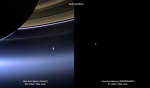 APOD: 2026 June 13 Б Interplanetary Earth
13.06.2026
In an interplanetary first, on July 19, 2013 Earth was photographed on the same day from two other worlds of the Solar System, innermost planet Mercury and ringed gas giant Saturn. Pictured...
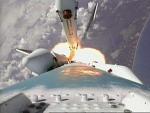 Launch of the Spirit Rover Toward Mars
28.07.2003
Next stop: Mars. Last month the first of two missions to Mars was launched from Cape Canaveral, Florida, USA above a Boeing Delta II rocket. Pictured above, solid fuel boosters are seen falling away as light from residual exhaust is reflected by the soaring rocket.
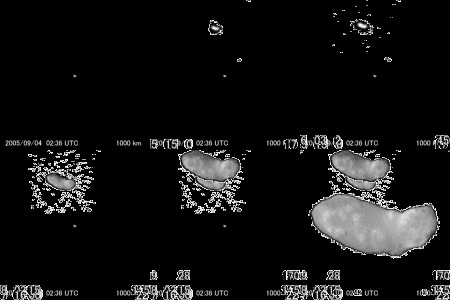 Approaching Asteroid Itokawa
19.09.2005
What are asteroids made of? To help find out, Japan's JAXA space agency launched the Hayabusa mission to rendezvous with asteroid Itokawa. Last week, the small robotic Hayabusa spacecraft arrived at asteroid Itokawa and stationed itself only 20 kilometers away.
 Jupiter and Ring in Infrared from Webb
20.07.2022
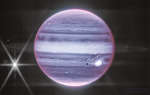
Why does Jupiter have rings? Jupiter's main ring was discovered in 1979 by NASA's passing Voyager 1 spacecraft, but its origin was then a mystery. Data from NASA's Galileo spacecraft that...
 Full Throttle For Deep Space 1
31.08.2000
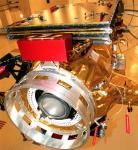
At full throttle the Deep Space 1 spacecraft's innovative ion drive produces about 1/50th of a pound of thrust ... a force so great that it would just about hold up a piece of paper on planet Earth! Still, powered by solar arrays ion propulsion systems can run continuously.
 Asteroid Eros Reconstructed
7.06.2009
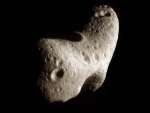
Orbiting the Sun between Mars and Earth, asteroid 433 Eros was visited by the robot spacecraft NEAR-Shoemaker in 2000 February. High-resolution surface images and measurements made by NEAR's Laser Rangefinder (NLR) have been combined into the above visualization based on the derived 3D model of the tumbling space rock.
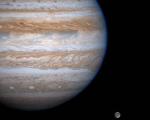 Jupiter Eyes Ganymede
12.12.2000
Who keeps an eye on the largest moon in the Solar System? This moon, visible on the lower right, is Ganymede, and the planet it orbits, Jupiter, seems to be keeping a watchful eye, as its Great Red Spot appears serendipitously nearby.
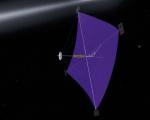 Solar Sail
21.08.2004
Could solar sailing become a future Olympic sport? Nearly 400 years ago astronomer Johannes Kepler observed comet tails blown by a solar breeze and suggested that vessels might likewise navigate through space using appropriately fashioned sails.
|
January February March April May June July August September October |
|||||||||||||||||||||||||||||||||||||||||||||||||