
|
You entered: spacecraft
 Thirteen Million Kilometers from Comet Tempel 1
29.06.2005
The Deep Impact spacecraft continues to close on Comet Tempel 1, a comet roughly the size of Manhattan. Early on July 3 (EDT), the Deep Impact spacecraft will separate in to two individual robotic spaceships, one called Flyby and the other called Impactor.
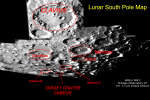 Target Crater Cabeus
8.10.2009
About 100 kilometers from the Moon's South Pole, 100 kilometer wide crater Cabeus is the target for two LCROSS mission spacecraft on course to impact the Moon tomorrow. The shadowed crater is strongly foreshortened in this mosaic, a representative view of the region for earthbound telescopes.
 Voyager Views Titan s Haze
5.09.2002
Launched in 1977, 25 years ago today, the Voyager 1 spacecraft's historic tour of the outer Solar System took it past Saturn in late 1980. On November 12, 1980, Voyager 1 recorded this view looking across the edge of Titan, Saturn's largest moon, from a distance of about 22,000 kilometers.
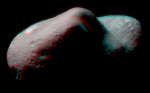 Stereo Eros
13.02.2021
Get out your red/blue glasses and float next to asteroid 433 Eros. Orbiting the Sun once every 1.8 years, the near-Earth asteroid is named for the Greek god of love. Still, its shape more closely resembles a lumpy potato than a heart.
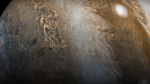 Perijove 11: Passing Jupiter
28.08.2022
Here comes Jupiter! NASA's robotic spacecraft Juno is continuing on its highly-elongated orbits around our Solar System's largest planet. The featured video is from perijove 11 in early 2018, the eleventh time Juno has passed near Jupiter since it arrived in mid-2016.
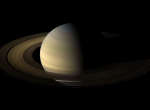 Saturn at Equinox
21.09.2014
How would Saturn look if its ring plane pointed right at the Sun? Before August 2009, nobody knew. Every 15 years, as seen from Earth, Saturn's rings point toward the Earth and appear to disappear.
 Jupiter's Great Dark Spot
19.03.2003
Seventeenth century astronomer Giovanni Domenico Cassini was an astute observer of Jupiter's Great Red Spot. So it seems only fitting that his namesake, the Cassini spacecraft, has enabled detailed observations of another planet-sized blemish -- Jupiter's Great Dark Spot.
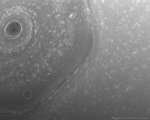 Over Saturns Turbulent North Pole
12.12.2016
The Cassini spacecraft's Grand Finale at Saturn has begun. The Grand Finale will allow Cassini to explore Saturn and some of Saturn's moons and rings in unprecedented detail. The first phase started...
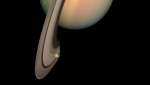 APOD: 2026 August 23 Б Cassini Approaches Saturn
23.08.2026
What would it look like to approach the grand planet Saturn? One doesn't have to just imagine -- the Cassini spacecraft did just this in 2004, recording thousands of images along the way, and hundreds of thousands more since entering orbit.
 Cerealia Facula
19.07.2018
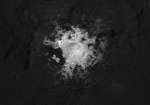
Cerealia Facula, also known as the brightest spot on Ceres, is shown in this stunning mosaic close-up view. The high-resolution image data was recorded by the Dawn spacecraft, in a looping orbit, from altitudes as low as 34 kilometers (21 miles) above the dwarf planet's surface.
|
January February March April May June July August September October |
|||||||||||||||||||||||||||||||||||||||||||||||||