
|
You entered: spacecraft
 Apollo 12 Visits Surveyor 3
24.11.1996
Apollo 12 was the second mission to land humans on the Moon. The landing site was picked to be near the location of Surveyor 3, a robot spacecraft that had landed on the moon three years earlier. Pictured above, Apollo 12 astronauts Conrad and Bean retrieve parts from the Surveyor.
 An Earth Ornament
25.12.1999
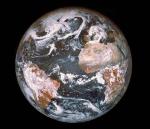
The Apollo 8 astronauts spent the 1968 Christmas Season orbiting the Moon, returning with striking images of both Moon and Earth from space - pictures which inspired the world. While in lunar orbit...
 Io's Active Volcanoes
27.10.1996
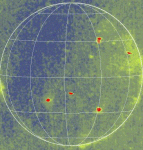
Why is Io green at night? In this just-released nighttime picture of Jupiter's moon Io, the red spots clearly show Io's current volcanically active regions. But what is causing the global green sheen? This telling picture was taken by the automated Galileo spacecraft currently orbiting Jupiter while Io was in Jupiter's shadow.
 A Flyby View of Ganymede
25.10.1996
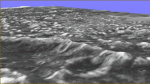
This is what it would look like to fly over the surface of Jupiter's moon Ganymede. NASA's robot spacecraft Galileo recently approached only 6000 miles from this frozen ice-ball of a moon. The above image is a digital reconstruction from two images taken during this flyby.
 Saturn from Above
6.03.2007
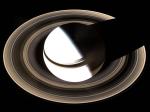
This image of Saturn could not have been taken from Earth. No Earth based picture could possibly view the night side of Saturn and the corresponding shadow cast across Saturn's rings. Since Earth is much closer to the Sun than Saturn, only the day side of the planet is visible from the Earth.
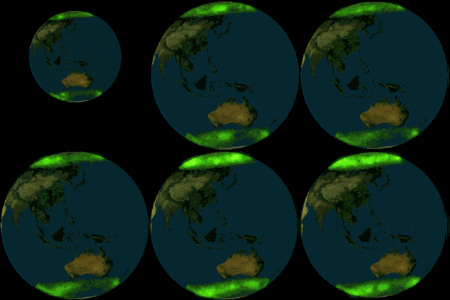 Auroras Over Both Earth Poles
14.11.2001
Auroras in the north and south can be nearly mirror images of each other. Such mirroring had been suspected for centuries but dramatically confirmed only last month by detailed images from NASA's orbiting Polar spacecraft.
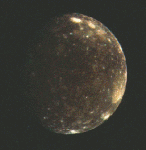 Callisto: Dark Smashed Iceball
6.09.1995
Callisto is a dirty battered world, showing the most beaten surface of Jupiter's major moons. Made of a rocky core covered by fractured ice, Callisto's past collisions with large meteors are evident as large craters surrounded by concentric rings.
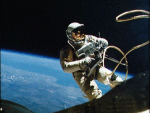 Walking in Space
15.06.1996
Pictured above is the first american astronaut to walk in space: Edward White. White is seen floating outside the Gemini 4 capsule in 1965. The term "spacewalk" is deceiving since astronauts do not actually walk - they float - usually without their feet touching anything solid. White was connected to the spaceship only by a thick tether.
 Surveyor Slides
9.11.1997
"Safe!" In September 1967 (during regular season play), the Surveyor 5 lander actually slid several feet while making a successful soft landing on the Moon's Mare Tranquillitatis. Equipped with television cameras and soil...
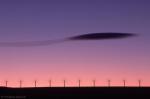 A Lenticular Cloud Over Wyoming
26.03.2003
Is that a cloud or a flying saucer? Both, although it is surely not an alien spacecraft. Lenticular clouds can be shaped like a saucer, and can fly in the sense that, like most clouds, they are composed of small water droplets that float on air.
|
January February March April May June July August September October |
|||||||||||||||||||||||||||||||||||||||||||||||||