
|
You entered: spacecraft
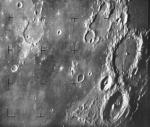 Moon Crashers
15.10.1999
On July 31, 1964, Ranger 7 crashed into the Moon. Seventeen minutes before impact it snapped this picture - the first image of the Moon ever taken by a U.S. spacecraft. Of course Ranger 7 was intended to crash, transmitting close-up pictures of the lunar surface during its final moments.
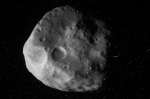 Views from Cassini at Saturn
18.06.2017
What has the Cassini orbiter seen at Saturn? The featured music video shows some of the early highlights. In the first time-lapse sequence (00:07), a vertical line appears that is really Saturn's thin rings seen nearly edge-on. Soon some of Saturn's moon shoot past.
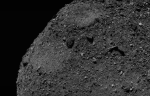 Tagging Bennu: The Movie
3.11.2020
This is what it looks like to punch an asteroid. Last month, NASA's robotic spacecraft OSIRIS-REx descended toward, thumped into, and then quickly moved away from the small near-Earth asteroid 101955 Bennu. The featured video depicts the Touch-And-Go (TAG) sampling event over a three-hour period.
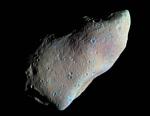 Asteroid Gaspra s Best Face
27.10.2002
Asteroid 951 Gaspra is a huge rock tumbling in space. Gaspra became one of the best-studied spacecraft Galileo flew by. In the above photograph, subtle color variations have been exaggerated to highlight changes in reflectivity, surface structure and composition.
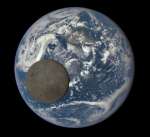 Full Earth, Full Moon
7.08.2015
The Moon was new on July 16. Its familiar nearside facing the surface of planet Earth was in shadow. But on that date a million miles away, the Deep Space Climate Observatory (DSCOVR) spacecraft's Earth Polychromatic Imaging Camera (EPIC) captured this view of an apparently Full Moon crossing in front of a Full Earth.
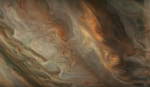 Perijove 16: Passing Jupiter
5.02.2019
Watch Juno zoom past Jupiter again. NASA's robotic spacecraft Juno is continuing on its 53-day, highly-elongated orbits around our Solar System's largest planet. The featured video is from perijove 16, the sixteenth time that Juno has passed near Jupiter since it arrived in mid-2016.
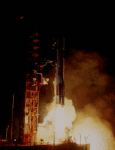 Surveyor Night Launch
3.11.1996
In early November of 1967, a dramatic night launch of an Atlas Centaur rocket from Cape Canaveral lofted the successful Surveyor 6 spacecraft toward the Moon. The Surveyor series of robotic probes carried out the first US lunar soft landings in preparation for the Apollo program.
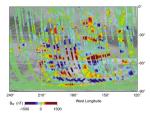 Magnetic Mars
4.05.1999
Mapping Mars from orbit, instruments on the Mars Global Surveyor (MGS) spacecraft have recently revealed banded magnetic field patterns - a startling and unanticipated suggestion that the Red Planet was more Earth-like in its distant past.
 APOD: 2024 April 21 Б Perijove 16: Passing Jupiter
21.04.2024
Watch Juno zoom past Jupiter. NASA's robotic spacecraft Juno is continuing on its now month-long, highly-elongated orbits around our Solar System's largest planet. The featured video is from perijove 16, the sixteenth time that Juno passed near Jupiter since it arrived in mid-2016.
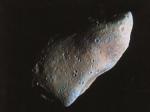 Asteroid Gaspra's Best Face
12.07.1998
Asteroid 951 Gaspra is a huge rock tumbling in space. Gaspra became one of the best-studied asteroids in 1991 when the spacecraft Galileo flew by. In the above photograph, subtle color variations have been exaggerated to highlight changes in reflectivity, surface structure and composition.
|
January February March April May June July August September October |
|||||||||||||||||||||||||||||||||||||||||||||||||