
|
You entered: spacecraft
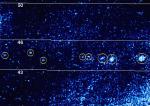 Lightning on Jupiter
12.05.1997
Does lightning occur only on Earth? Spacecraft in our Solar System have detected radio signals consistent with lightning on other planets, including Venus, Jupiter, Saturn, Uranus, and Neptune. In the above photograph, optical flashes from Jupiter were photographed recently by the Galileo orbiter. Each of the circled dots indicates lightning.
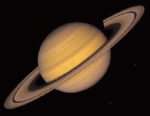 Saturn, Rings, and Two Moons
6.07.1995
This image of Saturn was made by NASA's robot spacecraft Voyager 2 as it began to explore the Saturn system in 1981. Saturn's famous rings are visible along with two of its moons, Rhea and Dione which appear as faint dots in the right and lower right part of the picture.
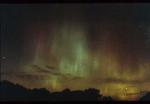 The Case of the Missing Aurora
21.10.1998
Sometimes, near midnight, auroras suddenly stop. Nobody knows why. This nightside gap in aurora was confirmed recently by D. Chua (U. Washington) and colleagues in data from the Ultraviolet Imager onboard the Polar spacecraft.
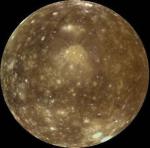 Callisto in True Color
11.05.1998
Callisto's surface has many stories to tell. The most distant of Jupiter's Galilean Moons, Callisto shows the highest density of impact craters in the Solar System, but harbors no volcanoes or even any large mountains. Callisto's surface is laced with cracks and craters from
 Jupiter from Voyager
18.07.1999
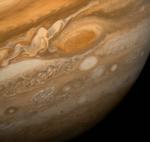
This picture of the planet Jupiter was taken by the Voyager 1 spacecraft as it passed the planet in 1979. Jupiter, a gas giant planet with no solid surface, is the largest planet in the Solar System and is made mostly of the hydrogen and helium.
 Neptune's Moon Proteus
4.11.1995
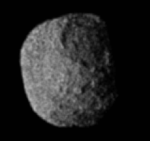
Proteus is the second largest moon of Neptune behind the mysterious Triton. Proteus was discovered only in 1982 by the Voyager 2 spacecraft. This is unusual since Neptune has a smaller moon - Nereid - which was discovered 33 years earlier from Earth.
 Catching Falling Stardust
21.11.1998
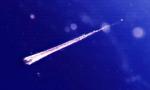
This carrot shaped track is actually little more than 5 hundredths of an inch long. It is the trail of a meteroid through the high-tech substance aerogel exposed to space by the shuttle launched EURECA (European Recoverable Carrier) spacecraft.
 An Earth Ornament
25.12.1996
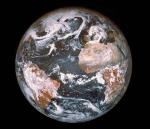
The Apollo 8 astronauts spent the 1968 Christmas Season in lunar orbit, returning with striking images of the Moon and Earth from space which inspired the world. While in lunar orbit...
 Arachnoids on Venus
20.01.1998
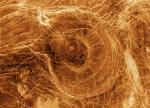
Arachnoids are large structures of unknown origin that have been found only on the surface of Venus. Arachnoids get their name from their resemblance to spider-webs. They appear as concentric ovals surrounded by a complex network of fractures, and can span 200 kilometers.
 A Meteoric View of Apollo 13
9.07.1995
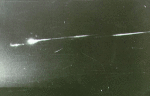
Meteors, also called shooting stars, normally begin as bits of dust from the tails of comets or even small pieces chipped off asteroids. Falling toward Earth, these particles enter the atmosphere at extremely high speeds. Friction with the air heats them up and makes them glow brightly.
|
January February March April May June July August September October |
|||||||||||||||||||||||||||||||||||||||||||||||||