
|
You entered: spacecraft
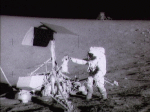 Apollo 12 Visits Surveyor 3
7.10.1995
Apollo 12 was the second mission to land humans on the Moon. The landing site was picked to be near the location of Surveyor 3, a robot spacecraft that had landed on the moon three years earlier. Pictured above, Apollo 12 astronauts Conrad and Bean retrieve parts from the Surveyor.
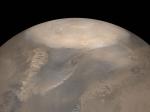 Spring Dust Storms at the North Pole of Mars
23.12.2002
Spring reached the north pole of Mars in May, and brought with it the usual dust storms. As the north polar cap begins to thaw, a temperature difference occurs between the cold frost region and recently thawed surface, resulting in swirling winds between the adjacent regions.
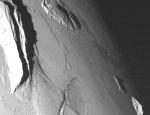 Io at Sunset
19.01.2003
How tall are mountains on Jupiter's moon Io? One way to find out is to view them at sunset. Tall structures facing the Sun are then better-lit and cast long shadows. The above...
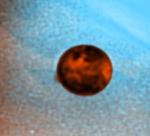 Eruption on Io
23.06.1997
There it goes again. Gas and rock were catapulted hundreds of kilometers into space as Jupiter's most volatile moon, Io, showed yet another impressive volcanic display in this just-released photograph by the Hubble Space Telescope.
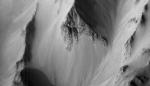 Mars: A Sheer Close Up
12.11.1997
As the Mars Global Surveyor spacecraft maneuvers toward its final mapping orbit, its cameras have been producing some sharp views of Mars. At a resolution of better than 30 feet per pixel, this image...
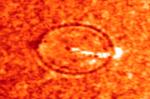 Solar Flares Cause Sun Quakes
1.06.1998
An 11th magnitude quake has been recorded on the Sun, immediately following a moderate solar flare. The quake was the first ever recorded on the Sun, but only because astronomers have only recently figured out when and how to find them using the orbiting SOHO spacecraft.
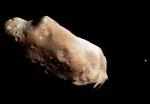 Ida and Dactyl: Asteroid and Moon
7.08.1999
This asteroid has a moon! The robot spacecraft Galileo currently exploring the Jovian system, encountered and photographed two asteroids during its long journey to Jupiter. The second asteroid it photographed, Ida, was discovered to have a moon which appears as a small dot to the right of Ida in this picture.
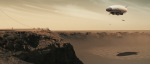 Wanderers
28.04.2018
How far out will humanity explore? If this video's fusion of real space imagery and fictional space visualizations is on the right track, then at least the Solar System. Some of the video...
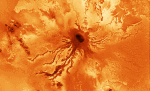 Closeup of an Io Volcano
4.08.1995
In 1979, one of NASA's Voyager spacecraft made a spectacular and unexpected discovery. Io, the innermost Galilean moon of Jupiter, was covered with volcanoes and some of them were erupting! In all, Voyager 1 observed nine volcanic eruptions during its encounter with the moon.
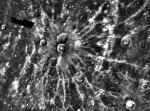 Degas Ray Crater on Mercury
7.12.1996
Like the Earth's Moon, Mercury is scarred with craters, testifying to an intense bombardment during the early history of the Solar System. In 1974, the Mariner 10 spacecraft surveyed this innermost planet up close, producing the only detailed images of its tortured surface.
|
January February March April May June July August September October |
|||||||||||||||||||||||||||||||||||||||||||||||||