
|
You entered: spacecraft
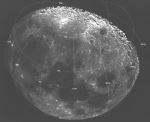 North to the Moon's Pole
22.06.1996
This image is from the voyage of the intrepid Galileo spacecraft as it passed above the Moon's north pole on its long journey to Jupiter. It was made over 60 years after Admiral Byrd became the first to fly over the Earth's north pole.
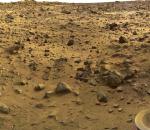 25 Years Ago: Vikings on Mars
21.07.2001
On July 20, 1976, NASA's Viking 1 lander become the first spacecraft to land on Mars, followed weeks later by its twin robot explorer, the Viking 2 lander. Operating on the Martian surface...
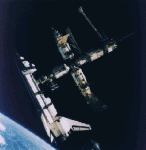 The Space Shuttle Docks with Mir
17.12.1995
Hundreds of kilometers above the Earth's surface, the United States Space Shuttle Atlantis docks with the Russian Space Station Mir. The photograph was taken by Nikolai Budarin from a Russian Soyuz spacecraft on July 4, 1995.
 The Grand Canyon of Mars
20.07.1995
The Mariner Valley, also known as the Valles Marineris canyon system, appears in this mosaic of images from NASA's Viking spacecraft as a huge gouge across the red planet. This "Grand Canyon" of Mars is about 2500 miles long and up to 4 miles deep.
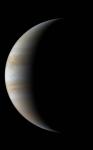 Farewell Jupiter
8.08.2001
Next stop: Saturn. The Cassini spacecraft, launched from Earth four years ago, has now swung past Jupiter and should arrive at Saturn in the year 2004. Pictured to the left is a parting shot from Cassini in January that would not have been possible from Earth: Jupiter showing a crescent phase.
 A Portrait of Saturn from Titan
16.07.1996
The above artistic portrait of Saturn depicts how it might look from Titan, Saturn's largest moon. In the foreground sits ESA's Huygens probe, which will be released by NASA's Cassini spacecraft. The Cassini mission to Saturn in currently planned for launch in late 1997.
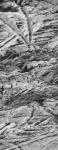 560 Kilometers Above Europa
3.03.1998
This is the closest photograph ever taken of Europa. Last December, NASA's spacecraft Galileo swept past the Jovian moon and took photographs which were released yesterday. Speculation that life-bearing oceans exist beneath Europa's surface caused NASA to put Galileo on orbits that approach Europa.
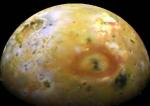 Io's Giant Volcano Pele
5.12.1996
Io has some very large volcanoes. One of the largest is evident near the center of the above photograph and named Pele, for the mythological Polynesian fire goddess. The Galileo spacecraft now orbiting Jupiter took this picture of Jupiter's most active moon in June, although it was released just last week.
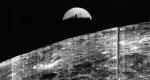 The Earth Also Rises
25.03.2000
The Lunar Orbiter 1 spacecraft was launched in 1966 to map the lunar surface in preparation for the Apollo moon landings. NASA's plucky robotic explorer performed its job well and pioneered this classic view of the Earth poised above the lunar horizon.
 Europa: Ancient Water World
5.09.1995
Beneath the cold icy surface of Jupiter's moon Europa are probably the only oceans of water in our Solar System outside of Earth. These oceans, possibly 50 kilometers deep, might also be the most likely local place to find extra-terrestrial life.
|
January February March April May June July August September October |
|||||||||||||||||||||||||||||||||||||||||||||||||