
|
You entered: spacecraft
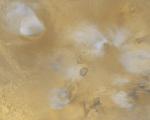 Tharsis Volcanos
18.06.1999
Ice crystal clouds float above the immense Tharsis volcanos of Mars in this recently released picture from NASA's Mars Global Surveyor spacecraft. Olympus Mons at the upper left is 340 miles across and almost 15 miles high - the largest volcano in the solar system.
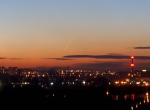 Comet Over Krakow
13.01.2007
Bright Comet McNaught (C/2006 P1) graced the twilight this week, seen by many and often described with superlatives. Watching the skies over Krakow, Poland, Andrzej Sawow recorded this view on Wednesday - with an ordinary handheld digital camera. He notes that "... astronomy is really for everyone who loves to look at the night sky.
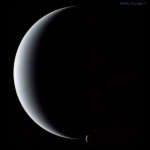 Crescent Neptune and Triton
25.07.2021
Gliding silently through the outer Solar System, the Voyager 2 spacecraft camera captured Neptune and Triton together in crescent phase. The elegant picture of the gas giant planet and its cloudy moon was taken from behind just after closest approach in 1989.
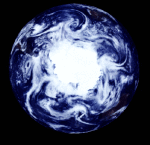 Summer at the South Pole
22.12.1995
December 22 marks the Winter Solstice - the beginning of winter in the Earth's northern hemisphere, and the first day of summer in the south! This view of Earth's southern hemisphere near the beginning of its summer was created using images from the Galileo spacecraft taken during the December 1990 flyby.
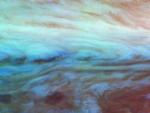 Jupiter: At The Belt-Zone Boundary
10.03.1997
Jupiter's thick atmosphere is striped by wind-driven cloud bands that remain fixed in latitude - dark colored bands are known as belts while light colored bands are zones. At Jupiter's belt-zone boundaries the shearing wind velocities can reach nearly 300 miles per hour.
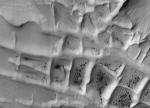 Mars: Ridges Near the South Pole
20.03.1998
No, it's not breakfast ... but looking down from an orbiting spacecraft, the odd intersecting ridges covering this area of Mars do present a waffle-like appearance. The cause of the ridge pattern is unknown but it suggests that more complex layered deposits lie below.
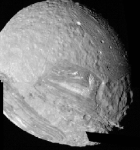 Uranus' Moon Miranda
24.12.1995
NASA's robot spacecraft Voyager 2 passed the planet Uranus and its moons in 1986. While the cloud tops of Uranus proved to be rather featureless, the surface of Miranda, the innermost of Uranus' large moons, showed several interesting features.
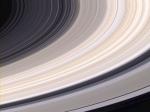 Saturns Rings in Natural Color
23.07.2004
What colors are Saturn's rings? Recent images from the Cassini spacecraft now orbiting Saturn confirm that different rings have slightly different colors. The above image shows their sometimes-subtle differences in brightness and color. The rings reflect sunlight and so, even if they were perfectly reflecting, would appear the color of the Sun.
 Approaching Pluto
27.05.2015
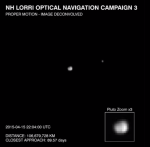
Here comes Pluto. NASA's robotic New Horizons spacecraft is now beyond the orbit of Neptune and closing fast on the Solar System's most famous unexplored world. The featured time lapse video shows...
 Pluto at Night
9.06.2016
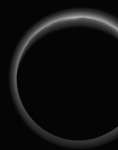
The night side of Pluto spans this shadowy scene. The spacebased view with the Sun behind the distant world was captured by New Horizons last July. The spacecraft was at a range of over 21,000 kilometers, about 19 minutes after its closest approach.
|
January February March April May June July August September October |
|||||||||||||||||||||||||||||||||||||||||||||||||