
|
You entered: spacecraft
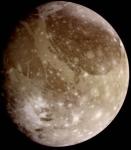 Ganymede: The Largest Moon in the Solar System
20.06.2000
If Ganymede orbited the Sun, it would be considered a planet. The reason is that Jupiter's moon Ganymede is not only the largest moon in the Solar System, it is larger than planets Mercury and Pluto.
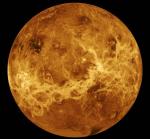 Venus Unveiled
3.09.2005
The surface of Venus is perpetually covered by a veil of thick clouds and remains hidden from even the powerful telescopic eyes of earth-bound astronomers. But in the early 1990s, using imaging radar...
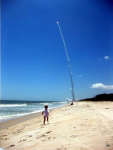 Chasing Juno
12.07.2016
Wait for me! In 2011, NASA's robotic mission Juno launched for Jupiter from Cape Canaveral, Florida, USA. Last week, Juno reached Jupiter and fired internal rockets to become only the second spacecraft to orbit our Solar System's largest planet.
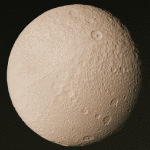 Saturn's Moon Tethys
24.11.1995
Tethys is one of the larger and closer moons of Saturn. It was visited by both Voyager spacecraft - Voyager 1 in November 1980 and by Voyager 2 in August 1981. Tethys is now known to be composed almost completely of water ice. Tethys shows a large impact crater that nearly circles the planet.
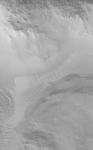 Mars in the New Year
6.01.2000
Many will long remember where they were and what they were doing when the calendar rolled over to the year 2000. On Mars, of course, that date was nothing special and the Mars Global Surveyor spacecraft continued with business as usual - systematically recording images of the Red Planet from orbit.
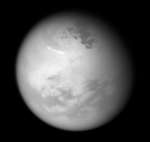 Northern Summer on Titan
22.06.2017
While yesterday's solstice brought summer to planet Earth's northern hemisphere, a northern summer solstice arrived for ringed planet Saturn nearly a month ago on May 24. Following the Saturnian seasons, its large moon Titan was captured in this Cassini spacecraft image from June 9.
 APOD: 2023 May 28 Б Ida and Dactyl: Asteroid and Moon
28.05.2023
This asteroid has a moon. The robot spacecraft Galileo on route to Jupiter in 1993 encountered and photographed two asteroids during its long interplanetary voyage. The second minor planet it photographed, 243 Ida, was unexpectedly discovered to have a moon.
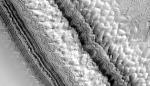 Layers of the Martian South Polar Cap
25.04.2000
The South Pole of Mars is stranger than was previously thought. Pictured above are unexpectedly complex layers photographed recently by the Mars Global Surveyor spacecraft currently orbiting Mars. The layers probably include carbon dioxide ice, water ice, rock and dust.
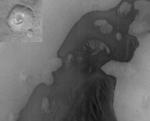 Martian Crater Shows Evidence of Dried Pond
3.06.1998
Did a pond once exist in this Martian crater? Recent photographs by the spacecraft Mars Global Surveyor, currently in orbit around Mars, show features unusual for Mars yet similar to a dried pond on Earth.
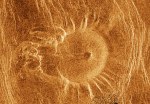 A Venusian Tick
23.08.1995
Data from the Magellan spacecraft has shown the Face of Venus to contain a host of volcanic features. This image shows an example of a fairly common type of venusian volcanic feature. Known...
|
January February March April May June July August September October |
|||||||||||||||||||||||||||||||||||||||||||||||||