
|
You entered: spacecraft
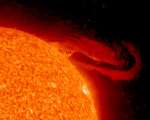 A Solar Prominence Unfurls
4.10.2008
On September 29, this magnificent eruptive solar prominence lifted away from the Sun's surface, unfurling into space over the course of several hours. Suspended in twisted magnetic fields, the hot plasma structure is many times the size of planet Earth and was captured in this view by the Sun-watching STEREO (Ahead) spacecraft.
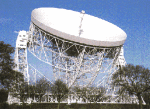 The 76 Meter Lovell Radio Telescope
8.03.1996
Jodrell Bank in England is the home of the Lovell Telescope one of the largest radio telescopes in the world. Completed in 1957 under the direction of Bernard Lovell, the 250 ft. diameter dish was the largest steerable radio telescope.
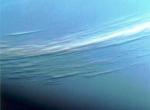 Two Hours Before Neptune
22.09.2002
Two hours before closest approach to Neptune in 1989, the Voyager 2 robot spacecraft snapped this picture. Clearly visible for the first time were long light-colored cirrus-type clouds floating high in Neptune's atmosphere. Shadows of these clouds can even be seen on lower cloud decks.
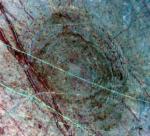 Impact on Europa
15.08.1997
This bull's-eye pattern marks the impact of a mountain-sized comet or asteroid on the icy surface of Jupiter's moon Europa. Recorded by the Galileo spacecraft in April of this year, the composite false color image clearly reveals the telltale concentric fractures which cover about
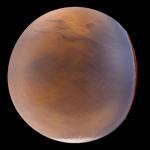 All of Mars
10.02.1998
Mars Global Surveyor is photographing Mars. The robot spacecraft arrived last September and continues to use solar panel aerobraking to help maneuver it to a better orbit to survey all of Mars The above image is a reconstruction of several photographs digitally combined to simulate a single vantage point 2700 kilometers above the Martian surface.
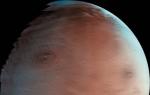 Good Morning Mars
19.06.1998
Looking down on the Northern Hemisphere of Mars on June 1, the Mars Global Surveyor spacecraft's wide angle camera recorded this morning image of the red planet. Mars Global Surveyor's orbit...
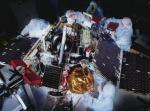 Invader From Earth
8.01.1999
These technicians are working on the solar-paneled Mars Polar Lander - yet another robotic spacecraft scheduled to invade the red planet. Mars Polar Lander is part of a series of missions focusing on a search for evidence of past or present life.
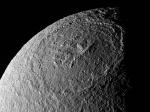 The Great Basin on Tethys
8.02.2006
Some moons wouldn't survive the collision. Tethys, one of Saturn's larger moons at about 1000 kilometers in diameter, survived the collision, but sports today the expansive impact crater Odysseus. Sometimes called...
 Nearer To Asteroid Eros
8.03.2000
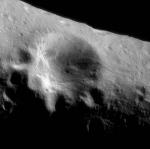
As the robot spacecraft NEAR lowers itself toward asteroid 433 Eros, more surface details are becoming visible. Last week's maneuvers brought NEAR to within 204 kilometers of the floating mountain's surface. With...
 CG4: A Ruptured Cometary Globule
6.08.2007
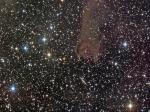
Can a gas cloud eat a galaxy? It's not even close. The odd looking "creature" or "hand" extending down from the top of the above photo is a gas cloud known as a cometary globule. This globule, however, has ruptured. Cometary globules are typically characterized by dusty heads and elongated tails.
|
January February March April May June July August September October |
|||||||||||||||||||||||||||||||||||||||||||||||||