
|
You entered: spacecraft
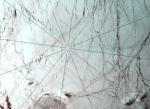 North Pole Below
20.10.2000
Orbiting over the north pole of planet Earth on May 5, the MODIS instrument on-board the Terra spacecraft, recorded this view of the ice cap 700 kilometers below. A radial grid centered on the pole is shown on top of the approximately true color image where each pixel covers about one square kilometer.
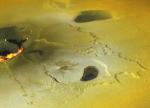 A Continuous Eruption on Jupiters Moon Io
6.06.2000
A volcano on Jupiter's moon Io has been photographed recently during an ongoing eruption. Hot glowing lava is visible on the left on this representative-color image. A glowing landscape of plateaus and valleys covered in sulfur and silicate rock surrounds the active volcano.
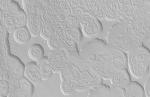 Swiss Cheese Like Landscape on Mars
27.03.2001
Why do parts of the south pole of Mars look like swiss cheese? This little-understood landscape features flat-topped mesas nearly 4 meters high and circular indentations over 100 meters across. Since this swiss-cheese topography...
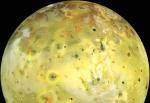 Io in True Color
15.07.2001
The strangest moon in the Solar System is bright yellow. This picture, showing Io's true colors, was taken in 1999 July by the Galileo spacecraft currently orbiting Jupiter. Io's colors derive from sulfur and molten silicate rock. The unusual surface of Io is kept very young by its system of active volcanoes.
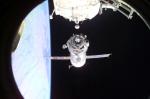 Leaving the International Space Station
17.12.2001
It was time to go home. During their eight days aboard the Earth-orbiting International Space Station (ISS), ESA Flight Engineer Claudie Haigner, Russian Commander Victor Afanasyev, and Russian Flight Engineer Konstantin Kozeev had completed several experiments and successfully delivered a new lifeboat.
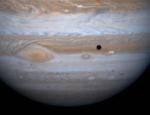 Jupiter, Io, and Shadow
7.12.2002
Pictured above is the innermost of Jupiter's Galilean satellites, Io, superposed in front of the gas giant planet. To the left of Io is a dark spot that is Io's own shadow. A solar eclipse would be seen from within the shadow spot on Jupiter.
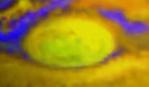 Jupiter: The Great Yellow Spot
11.03.1997
What happened to Jupiter's Great Red Spot? Operating at a chilly 55 degrees Kelvin, the Galileo Spacecraft's Near Infrared Mapping Spectrometer (NIMS) recorded this composite image of Jupiter's Great Red Spot in late June 1996.
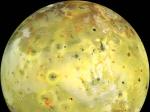 Io in True Color
2.05.2004
The strangest moon in the Solar System is bright yellow. This picture, showing Io's true colors, was taken in 1999 July by the Galileo spacecraft that orbited Jupiter from 1995 to 2003. Io's colors derive from sulfur and molten silicate rock.
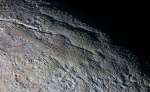 Pluto s Snakeskin Terrain
25.09.2015
A mountainous region informally known as Tartarus Dorsa sprawls some 530 kilometers (330 miles) across this Plutonian landscape. Recently downloaded from New Horizons, it combines blue, red, and infrared image data in an extended color view captured near the spacecraft's close approach to Pluto on July 14.
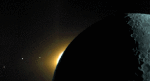 The Ecliptic Plane
14.10.2000
The Plane of the Ecliptic is well illustrated in this picture from the 1994 lunar prospecting Clementine spacecraft. Clementine's star tracker camera image reveals (from right to left) the Moon lit by Earthshine, the Sun's corona rising over the Moon's dark limb, and the planets Saturn, Mars, and Mercury.
|
January February March April May June July August September October |
|||||||||||||||||||||||||||||||||||||||||||||||||