
|
You entered: spacecraft
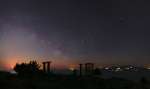 Take a Picture of Saturn
19.07.2013
Take a picture of Saturn in the sky tonight. You could capture a view like this one. Recorded just last month looking toward the south, planet Earth and ruins of the ancient temple of Athena at Assos, Turkey are in the foreground.
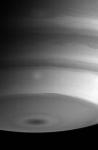 Southern Saturn from Cassini
18.10.2004
What happens to Saturn's pervasive clouds at its South Pole? Visible in the above image of Saturn are bright bands, dark belts and a dark spot right over the South Pole. The above...
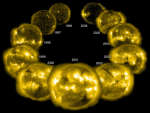 A Complete Solar Cycle from SOHO
3.12.2007
Every eleven years, our Sun goes through a solar cycle. A complete solar cycle has now been imaged by the sun-orbiting SOHO spacecraft, celebrating the 12th anniversary of its launch yesterday. A solar cycle...
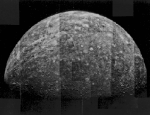 Mercury: Closest Planet to the Sun
14.08.1995
This picture was compiled from images taken by the NASA spacecraft Mariner 10 which flew by the planet three times in 1974. Mercury is the closest planet to the Sun, the second hottest planet (Venus gets hotter), and the second smallest planet (Pluto is smaller).
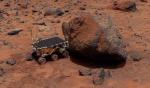 Mars Rocks, Sojourner Rolls
14.08.1997
This sharp color image featuring Mars rock Yogi and the rolling Sojourner robot shows off Yogi's startling two-toned surface. Yogi appears to be leaning into the prevailing winds causing some to suggest that its color contrast may be caused by the accumulation of rust colored dust on its windward face.
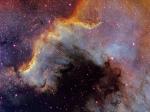 The Cygnus Wall of Star Formation
21.06.2005
The North America Nebula in the sky can do what North Americans on Earth cannot -- form stars. Specifically, in analogy to the Earth-confined continent, the bright part that appears as Central America and Mexico is actually a hot bed of gas, dust, and newly formed stars known as the Cygnus Wall.
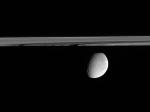 Slightly Beneath Saturns Ring Plane
5.04.2006
When orbiting Saturn, be sure to watch for breathtaking superpositions of moons, rings, and shadows. One such picturesque vista was visible recently to the robot Cassini spacecraft now orbiting Saturn. In late February, Cassini captured a Rhea, the second largest moon of Saturn, while looking up from slightly beneath Saturn's expansive ring plane.
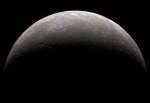 Crescent Mercury in Color
26.01.2008
Hard to spot against the twilight glow near planet Earth's horizon, a crescent Mercury was imaged close up by the MESSENGER spacecraft early last week. Colors in this remarkable picture were created using data recorded through infrared, red, and violet filters.
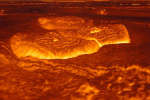 Venus Once Molten Surface
1.08.2010
If you could look across Venus with radar eyes, what might you see? This computer reconstruction of the surface of Venus was created from data from the Magellan spacecraft. Magellan orbited Venus and used radar to map our neighboring planet's surface between 1990 and 1994.
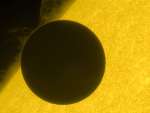 Venus at the Edge
9.06.2012
As its June 6 2012 transit begins Earth's sister planet crosses the edge of the Sun in this stunning view from the Hinode spacecraft. The timing of limb crossings during the rare transits was used historically to triangulate the distance to Venus and determine a value for the Earth-Sun distance called the astronomical unit.
|
January February March April May June July August September October |
|||||||||||||||||||||||||||||||||||||||||||||||||