
|
You entered: spacecraft
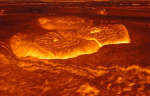 Venus Once Molten Surface
23.06.2013
If you could look across Venus with radar eyes, what might you see? This computer reconstruction of the surface of Venus was created from data from the Magellan spacecraft. Magellan orbited Venus and used radar to map our neighboring planet's surface between 1990 and 1994.
 A Great White Spot on Rhea
30.05.2005
Why caused this great white spot on the surface of Saturn's moon Rhea? The spot was first noticed last year by the robot Cassini spacecraft now orbiting Saturn. Cassini's flyby of Rhea in April imaged in the spot in great detail.
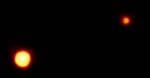 Pluto: The Frozen Planet
13.02.1999
This portrait of Pluto and its companion Charon was taken by the Hubble Space Telescope in 1994. Pluto is usually the most distant planet from the Sun but because of its eccentric orbit Pluto crossed inside of Neptune's orbit in 1979.
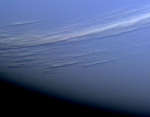 Two Hours Before Neptune
8.08.2010
Two hours before closest approach to Neptune in 1989, the Voyager 2 robot spacecraft snapped this picture. Clearly visible for the first time were long light-colored cirrus-type clouds floating high in Neptune's atmosphere. Shadows of these clouds can even be seen on lower cloud decks.
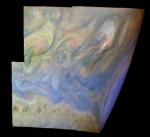 West Of The Great Red Spot
26.12.1997
The turbulent region West of Jupiter's Great Red Spot is highlighted in this recent picture constructed from data recorded by the Galileo spacecraft. The image is color coded to show cloud height and thickness; white clouds are high and thick, light blue clouds are high and thin, and reddish clouds are low.
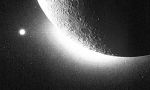 Sunshine, Earthshine at the Lunar Limb
30.05.1996
This dramatic image of the Moon's edge against a background of distant stars is from a perspective impossible for groundbased telescopes. It was taken by a star tracker camera onboard the Clementine spacecraft.
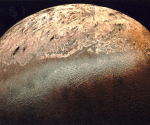 Triton: Neptune's Largest Moon
23.11.1997
On October 10th, 1846, William Lassell was observing the newly discovered planet Neptune. He was attempting to confirm his observation, made just the previous week, that Neptune had a ring. But this time he discovered that Neptune had a satellite as well.
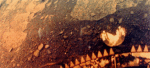 A Venus Landing
24.01.1999
This image is part of the first color panoramic view from Venus. It was transmitted by a TV camera on the Soviet Venera 13 lander which parachuted to thesurface on March 1, 1982. Venus...
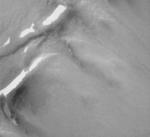 Ski Mars
1.04.1999
These brightly reflecting fields of snow or frost are on the slopes of a crater rim in the northern hemisphere of Mars. They are 500 meters or so long and have lasted through about eight months of the Red Planet's spring and summer weather.
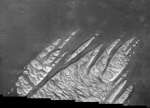 White Rock Fingers on Mars
30.10.2011
What caused this unusual light rock formation on Mars? Intrigued by the possibility that they could be lakebed dried-up, detailed studies of these fingers now indicate a more mundane possibility: volcanic ash. Studying the exact color of the formation indicated the possible volcanic origin.
|
January February March April May June July August September October |
|||||||||||||||||||||||||||||||||||||||||||||||||