
|
You entered: spacecraft
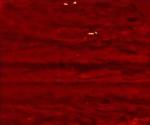 Night Lightning on Jupiter
16.12.1997
Why is there lightning on Jupiter? Lightning is a sudden rush of electrically charged particles from one location to another. To create lightning, charges must first separate inside a cloud. On Earth, drafts of colliding ice and water droplets usually create this charge separation, but what happens on Jupiter?
 Seeing Through Saturns C Ring
20.09.2004
Are Saturn's rings transparent? The Cassini spacecraft that recently entered orbit around Saturn has confirmed that some of Saturn's rings are more transparent than others. Pictured above, Saturn's main A, B, and C rings can be seen, top to bottom, superposed against the gas giant planet.
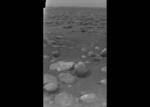 Huygens Images Titan s Surface
15.01.2005
After a seven year interplanetary voyage on board the the Cassini spacecraft, the European Space Agency's Huygens probe parachuted to a historic landing on Saturn's moon Titan on January 14. Above...
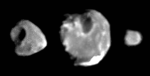 Jupiters Moons Thebe, Amalthea, and Metis
8.05.2000
The robot spacecraft Galileo in orbit around Jupiter has recently photographed the inner moons of Jupiter in greater detail than ever before. These pictures of Thebe, Amalthea, and Metis are shown to scale, and reveal details as small as three kilometers across. Amalthea, by contrast, has a total length of about 200 kilometers.
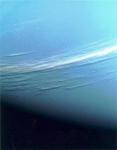 Two Hours Before Neptune
5.10.1999
Two hours before closest approach to Neptune in 1989, the Voyager 2 robot spacecraft snapped this picture. Clearly visible for the first time were long light-colored cirrus-type clouds floating high in Neptune's atmosphere. Shadows of these clouds can even be seen on lower cloud decks.
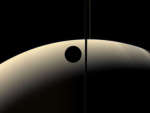 Crescent Rhea Occults Crescent Saturn
3.01.2015
Soft hues, partially lit orbs, a thin trace of the ring, and slight shadows highlight this understated view of the majestic surroundings of the giant planet Saturn. Looking nearly back toward the Sun, the robot Cassini spacecraft now orbiting Saturn captured crescent phases of Saturn and its moon Rhea in color a few years ago.
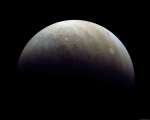 Southern Jupiter from Perijove 3
17.12.2016
Southern Jupiter looms some 37,000 kilometers away in this JunoCam image from December 11. The image data was captured near Juno's third perijove or closest approach to Jupiter, the spacecraft still in its 53 day long looping orbit.
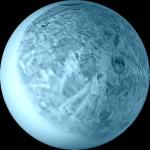 Hamlet of Oberon
31.01.1998
What's in a name? Since 1919, the International Astronomical Union has been charged with the task of establishing "conventional" nomenclature for planets, satellites, and surface features. For the remote Uranian system of moons, namesakes from Shakespearean works have been chosen.
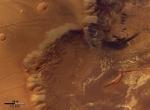 Melas Chasma
29.07.2004
Steep cliffs drop into the rugged terrain of Melas Chasma in this stunning view from the Mars Express spacecraft orbiting the Red Planet. At a scale of 16 meters per pixel, the image data...
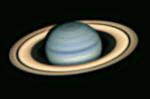 Saturn from Earth
2.09.1998
Saturn is the second largest planet in our Solar System. Saturn has been easily visible in the sky since history has been recorded. Galileo used one of the first telescopes in 1610 to discover Saturn's rings, which he first thought were moons.
|
January February March April May June July August September October |
|||||||||||||||||||||||||||||||||||||||||||||||||