
|
You entered: star
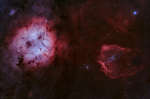 Elephant, Bat, and Squid
23.07.2021
Sprawling emission nebulae IC 1396 and Sh2-129 mix glowing interstellar gas and dark dust clouds in this 10 degree wide field of view toward the northern constellation Cepheus the King. Energized by its bluish central star IC 1396 (left) is hundreds of light-years across and some 3,000 light-years distant.
 Comet 12P/Pons Brooks in Northern Spring
9.03.2024
As spring approaches for northern skygazers Comet 12P/Pons-Brooks is growing brighter. Currently visible with small telescopes and binoculars the Halley-type comet could reach naked eye visibility in the coming weeks. Seen despite a foggy...
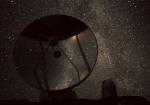 La Silla s Starry Night
23.09.2004
On clear, moonless nights, the stars still come out with a vengance above the high-altitude La Silla astronomical observatory. Taking advantage of a recent visit to this first European Southern Observatory (ESO) site constructed on a mountain top in Chile, ESO software engineer Nico Housen recorded this stunning sky view.
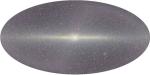 The Near Infrared Sky
18.05.2000
Was this picture taken from outside our Galaxy? No, it is a composite taken from Earth orbit, well inside our Milky Way Galaxy. In light just a little too red for human eyes...
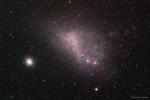 APOD: 2007 October 1- The Small Cloud of Magellan
1.10.2007
Portuguese navigator Ferdinand Magellan and his crew had plenty of time to study the southern sky during the first circumnavigation of planet Earth. As a result, two celestial wonders easily visible for southern hemisphere skygazers are known as the Clouds of Magellan.
 Spitzer s Milky Way
5.06.2008
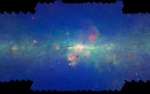
The Spitzer Space Telescope's encompasing infrared view of the plane of our Milky Way Galaxy is hard to appreciate in just one picture. In fact, more than 800,000 frames of data from...
 Milky Way Over Switzerland
21.02.2011
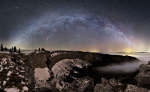
What's visible in the night sky during this time of year? To help illustrate the answer, a beautiful land, cloud, and skyscape was captured earlier this month over NeuchБtel, Switzerland. Visible in the foreground were the snow covered cliffs of the amphitheater shaped Creux du Van, as well as distant trees, and town-lit clouds.
 Messier 101
15.04.2011
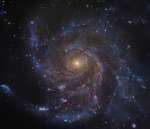
Big, beautiful spiral galaxy M101 is one of the last entries in Charles Messier's famous catalog, but definitely not one of the least. About 170,000 light-years across, this galaxy is enormous, almost twice the size of our own Milky Way galaxy.
 An Elephant s Trunk in Cepheus
16.01.2018
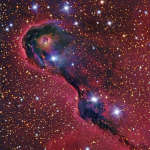
With image data from telescopes large and small, this close-up features the dusty Elephant's Trunk Nebula. It winds through the emission nebula and young star cluster complex IC 1396, in the high and far off constellation of Cepheus. Also known as vdB 142, the cosmic elephant's trunk is over 20 light-years long.
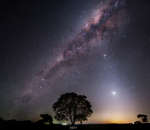 A Light and Dusty Night
2.10.2021
Posing as a brilliant evening star, Venus lies near the western horizon in this southern hemisphere, early spring, night skyscape. To create the composite view exposures tracking the sky and fixed for the foreground were taken on September 25 from Cascavel in southern Brazil.
|
January February March April May June July August September October |
|||||||||||||||||||||||||||||||||||||||||||||||||