
|
You entered: star
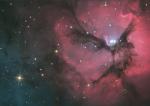 A Beautiful Trifid
1.09.2003
The beautiful Trifid Nebula (aka M20), a photogenic study in cosmic contrasts, lies about 5,000 light-years away toward the nebula rich constellation Sagittarius. A star forming region in the plane of our galaxy...
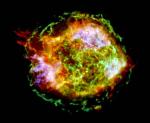 APOD: 2004 August 26- Cassiopeia A in a Million
26.08.2004
One million seconds of x-ray image data were used to construct this view of supernova remnant Cassiopeia A, the expanding debris cloud from a stellar explosion. The stunningly detailed image from the Chandra Observatory will allow an unprecedented exploration of the catastrophic fate that awaits stars much more massive than the Sun.
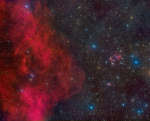 Barnard Stares at NGC 2170
19.01.2013
A gaze across a cosmic skyscape, this telescopic mosaic reveals the continuous beauty of things that are. The evocative scene spans some 6 degrees or 12 Full Moons in planet Earth's sky. At the left, folds of red, glowing gas are a small part of an immense, 300 light-year wide arc.
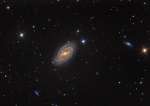 Messier 109
23.05.2013
Beautiful barred spiral galaxy M109, 109th entry in Charles Messier's famous catalog of bright Nebulae and Star Clusters, is found just below the Big Dipper's bowl in the northern constellation Ursa Major.
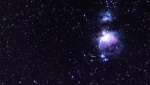 Geostationary Highway through Orion
16.01.2017
Put a satellite in a circular orbit about 42,000 kilometers from the center of the Earth and it will orbit once in 24 hours. Because that matches Earth's rotation period, it is known as a geosynchronous orbit.
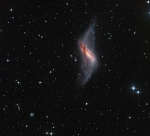 Polar Ring Galaxy NGC 660
17.02.2017
NGC 660 is featured in this cosmic snapshot. Over 40 million light-years away and swimming within the boundaries of the constellation Pisces, NGC 660's peculiar appearance marks it as a polar ring galaxy.
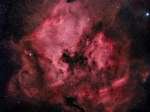 North America and the Pelican
1.12.2017
Fans of our fair planet might recognize the outlines of these cosmic clouds. On the left, bright emission outlined by dark, obscuring dust lanes seems to trace a continental shape, lending the popular name North America Nebula to the emission region cataloged as NGC 7000.
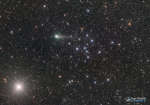 Comet C 2017 K2 (PanSTARRS)
30.06.2022
Imaged on June 20 2022, comet C/2017 K2 (PanSTARRS) shares this wide telescopic field of view with open star cluster IC 4665 and bright star Beta Ophiuchi, near a starry edge of the Milky Way.
 Hydrogen Clouds of M33
13.10.2023
Gorgeous spiral galaxy Messier 33 seems to have more than its fair share of glowing hydrogen gas. A prominent member of the local group of galaxies, M33 is also known as the Triangulum Galaxy and lies a mere 3 million light-years away.
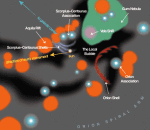 The Local Bubble and the Galactic Neighborhood
17.02.2002
What surrounds the Sun in this neck of the Milky Way Galaxy? Our current best guess is depicted in the above map of the surrounding 1500 light years constructed from various observations and deductions.
|
January February March April May June July August September October |
|||||||||||||||||||||||||||||||||||||||||||||||||