
|
You entered: Saturn
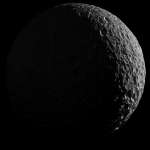 Mimas in Saturnlight
16.03.2017
Peering from the shadows, the Saturn-facing hemisphere of Mimas lies in near darkness alongside a dramatic sunlit crescent. The mosaic was captured near the Cassini spacecraft's final close approach on January 30, 2017. Cassini's camera was pointed in a nearly sunward direction only 45,000 kilometers from Mimas.
 Mimas in Saturnlight
3.08.2019
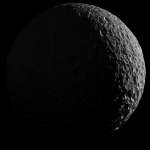
Peering from the shadows, the Saturn-facing hemisphere of Mimas lies in near darkness alongside a dramatic sunlit crescent. The mosaic was captured near the Cassini spacecraft's final close approach on January 30, 2017. Cassini's camera was pointed in a nearly sunward direction only 45,000 kilometers from Mimas.
 Mimas in Saturnlight
30.07.2021
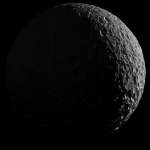
Peering from the shadows, the Saturn-facing hemisphere of Mimas lies in near darkness alongside a dramatic sunlit crescent. The mosaic was captured near the Cassini spacecraft's final close approach on January 30, 2017. Cassini's camera was pointed in a nearly sunward direction only 45,000 kilometers from Mimas.
 APOD: 2025 April 30 Б A Happy Sky over Bufa Hill in Mexico
30.04.2025
Sometimes, the sky itself seems to smile. A few days ago, visible over much of the world, an unusual superposition of our Moon with the planets Venus and Saturn created just such an iconic facial expression.
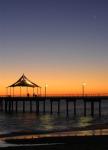 Three Planets by the Sea
2.07.2005
On Tuesday, June 28th, the setting Sun flooded the horizon with a beautiful warm light in this view from the beach beside the pier at Brighton in Adelaide, South Australia. The Sun also illuminated three planets gathered in the western sky, Mercury, Venus, and Saturn.
 Moon Over California
18.04.1999
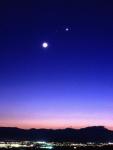
The Moon, Saturn, and Venus shine above while city lights twinkle below in the deepening twilight of March 19. Taken from outside Indio, California, the photo shows the city lights of Indio and nearby Palm Springs.
 Moon, Planets, and Rocket Trails
14.07.1999
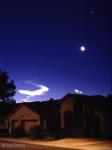
Are you an early riser? Over the last month or so, the bright planets Jupiter and Saturn have come to adorn eastern skies before sunrise. In fact, astrophotographer Joe Orman anticipated that an early...
 Bright Planets, Crescent Moon
11.10.2007
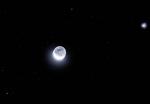
Early risers are currently enjoying the sight of dazzling Venus, near the eastern horizon as the morning star. Recorded on October 7, this predawn skyview does feature Venus at the upper right. It also includes a crescent Moon and Saturn (lower left).
 Atlas, Daphnis, and Pan
6.07.2017
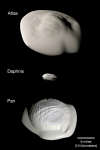
Atlas, Daphnis, and Pan are small, inner, ring moons of Saturn, shown at the same scale in this montage of images from the still Saturn-orbiting Cassini spacecraft. In fact, Daphnis was discovered in Cassini images from 2005. Atlas and Pan were first sighted in images from the Voyager 1 and 2 spacecraft.
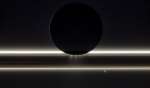 Enceladus in Silhouette
15.02.2018
One of our Solar System's most tantalizing worlds, Enceladus is backlit by the Sun in this Cassini spacecraft image from November 1, 2009. The dramatic illumination reveals the plumes that continuously spew into space from the south pole of Saturn's 500 kilometer diameter moon.
|
January February March April May June July August September October |
|||||||||||||||||||||||||||||||||||||||||||||||||