
|
You entered: Saturn
 Ring Scan
23.11.2016
Scroll right and you can cruise along the icy rings of Saturn. This high resolution scan is a mosaic of images presented in natural color. The images were recorded in May 2007 over about 2.5 hours as the Cassini spacecraft passed above the unlit side of the rings.
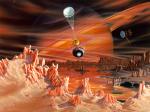 Titan Surmised
19.12.2004
What does the surface of Titan look like? Thick clouds have always made Saturn's largest moon so mysterious that seemingly farfetched hypotheses like methane rain and lakes have been seriously considered. Later this...
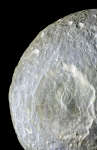 Herschel Crater on Mimas
12.08.2022
Mimas, small 400 kilometer-diameter moon of Saturn, is host to 130 kilometer-diameter Herschel crater, one of the larger impact craters in the entire Solar System. The robotic Cassini spacecraft orbiting Saturn in 2010 recorded...
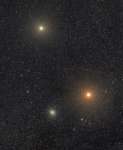 M22 and the Wanderers
11.04.2018
Wandering through the constellation Sagittarius, bright planets Mars and Saturn appeared together in early morning skies over the last weeks. They are captured in this 3 degree wide field-of-view from March 31 in a close celestial triangle with large globular star cluster Messier 22.
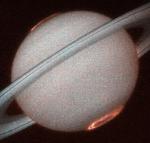 Saturnian Aurora
22.01.1999
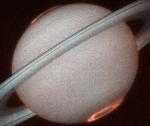
Girdling the second largest planet in the Solar System, Saturn's Rings are one of the most spectacular sights for earthbound telescopes. This image from the orbiting Hubble Space Telescope's STIS instrument, offers a striking view of another kind of ring around Saturn - pole encircling rings of ultraviolet aurora.
 Saturnian Aurora
22.12.2001
the second largest planet in the Solar System, Saturn's Rings are one of the most spectacular sights for earthbound telescopes. This image from the orbiting Hubble Space Telescope's STIS instrument, offers a striking view of another kind of ring around Saturn - pole encircling rings of ultraviolet aurora.
 Cassini To Venus
16.10.1997
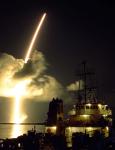
NASA's Saturn Explorer Cassini with ESA's Titan Probe Huygens attached successfully rocketed into the skies early yesterday morning. The mighty Titan 4B Centaur rocket is seen here across the water gracefully arcing away from Launch Complex 40 at Cape Canaveral Air Station.
 Saturnian Aurora
8.01.1998
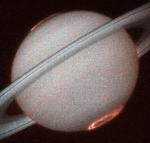
Girdling the second largest planet in the Solar System, Saturn's Rings are one of the most spectacular sights for earthbound telescopes. This recently released image, from the orbiting Hubble Space Telescope's STIS instrument, offers a striking view of another kind of ring around Saturn - pole encircling rings of ultraviolet aurora.
 Saturnian Aurora
17.09.2000
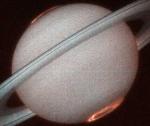
Girdling the second largest planet in the Solar System, Saturn's Rings are one of the most spectacular sights for earthbound telescopes. This image from the orbiting Hubble Space Telescope's STIS instrument, offers a striking view of another kind of ring around Saturn - pole encircling rings of ultraviolet aurora.
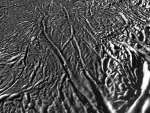 Close Up of Enceladus Tiger Stripes
31.03.2008
Could life exist beneath Enceladus? A recent flyby of Saturn's icy moon has bolstered this fascinating idea. Two years ago, images from the robotic Cassini spacecraft orbiting Saturn led astronomers to the undeniable...
|
January February March April May June July August September October |
|||||||||||||||||||||||||||||||||||||||||||||||||