
|
You entered: apod
 APOD: 2026 March 14 Б A Year for K2-315b
14.03.2026
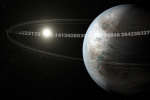
Want to visit a planet that has 3.14 days in a year? Then plan a trip to K2-315b, an earth-sized planet orbiting around a cool, red, M dwarf star about once every 3.14 days.
 APOD: 2024 September 23 Б Comet Tsuchinshan ATLAS Approaches
23.09.2024
What will happen as this already bright comet approaches? Optimistic predictions have Comet C/2023 A3 (TsuchinshanБATLAS) briefly becoming easily visible to the unaided eye -- although the future brightness of comets are notoriously hard to predict, and this comet may even break up in warming sunlight.
 APOD: 2026 May 15 Б R3 PanSTARRS: An Orion Comet
15.05.2026
Comet R3 PanSTARRS might be best remembered as an Orion comet. A key reason is because Comet C/2025 R3 (PanSTARRS) was near its most spectacular -- in terms of tail visibility -- when passing in front of the iconic constellation.
 APOD: 2023 February 14 Б The Heart and Soul Nebulas
14.02.2023
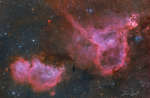
Is the heart and soul of our Galaxy located in Cassiopeia? Possibly not, but that is where two bright emission nebulas nicknamed Heart and Soul can be found. The Heart Nebula, officially dubbed IC 1805 and visible in the featured image on the upper right, has a shape reminiscent of a classical heart symbol.
 APOD: 2023 August 9 Б Meteor Shower: Perseids from Perseus
9.08.2023
This is a good week to see meteors. Comet dust will rain down on planet Earth, streaking through dark skies during peak nights of the annual Perseid Meteor Shower. The featured composite image was taken during the 2018 Perseids from the Poloniny Dark Sky Park in Slovakia.
 APOD: 2023 November 26 Б A Dust Jet from the Surface of Comet 67P
26.11.2023
Where do comet tails come from? There are no obvious places on the nuclei of comets from which the jets that create comet tails emanate. In 2016, though, ESA's Rosetta spacecraft not only imaged a jet emerging from Comet 67P/Churyumov-Gerasimenko, but flew right through it.
 APOD: 2024 February 26 Б Martian Moon Eclipses Martian Moon
26.02.2024
What if there were two moons in the sky -- and they eclipsed each other? This happens on Mars. The featured video shows a version of this unusual eclipse from space. Pictured are the two moons of Mars: the larger Phobos, which orbits closer to the red planet, and the smaller Deimos, which orbits further out.
 APOD: 2025 April 16 Б Halo of the Cats Eye
16.04.2025
What created the unusual halo around the Cat's Eye Nebula? No one is sure. What is sure is that the Cat's Eye Nebula (NGC 6543) is one of the best known planetary nebulae on the sky.
 APOD: 2025 April 23 Б An Almost Everything Sky
23.04.2025
This surprising sky has almost everything. First, slanting down from the upper left and far in the distance is the central band of our Milky Way Galaxy. More modestly, slanting down from the upper right and high in Earth's atmosphere is a bright meteor.
 APOD: 2025 May 20 Б Milky Way over Maunakea
20.05.2025
Have you ever seen the band of our Milky Way Galaxy? In a clear sky from a dark location at the right time, a faint band of light becomes visible across the sky. Soon after your eyes become dark adapted, you might spot the band for the first time. It may then become obvious.
|
January February March April May June July August |
||||||||||||||||||||||||||||||||||||||||||||||||||||||||