
|
You entered: light
 Twilight in a Flower
6.05.2023
Transformed into the petals of a flower, 16 exposures show the passage of day into night in this creative timelapse skyscape. Start at the top and move counterclockwise to follow consecutive moments as the twilight sky turns an ever darker blue and night blossoms.
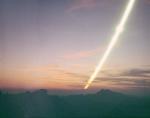 A Setting Sun Trail
29.07.2002
The Sun appears to move on the sky because the Earth rotates. The extreme brightness of the Sun, however, makes it difficult to capture a sun-trail -- the path the Sun traces on the sky.
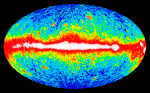 Gamma Ray Sky Map
23.06.1995
What if you could "see" gamma rays? This computer processed image represents a map of the entire sky at photon energies above 100 million electron Volts. These gamma-ray photons are more than 40 million times more energetic than visible light photons and are blocked from the Earth's surface by the atmosphere.
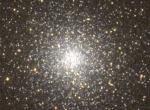 Globular Cluster 47 Tucanae
19.09.1997
Stars come in bunches. Of the over 200 globular star clusters that orbit the center of our Milky Way Galaxy, 47 Tucanae is the second brightest globular cluster (behind Omega Centauri). Known to some affectionately as 47 Tuc or NGC 104, it is only visible from the Southern Hemisphere.
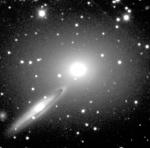 Seeing Through Galaxies
5.12.1997
In this dramatic picture, spiral galaxy NGC 5091 appears in the foreground. Tilted nearly edge-on, the dust lanes between its spiral arms are clearly visible. The large elliptical galaxy NGC 5090 lies just beyond it - both are about 100 million light years distant in the southern constellation Centaurus. Can you see through the spiral galaxy?
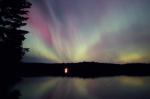 A Colorful Aurora
1.09.1998
A solar storm overtook the Earth on August 26th. The Earth survived unscathed, as usual, although many northerners reported an impressive display of aurora. Many of these auroras changed rapidly, with patterns appearing and disappearing sometimes in less than a second. Out away from city lights, observers also reported an unusually spectacular array of colors.
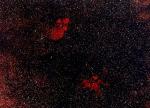 The Cat's Paw Nebula
7.12.1999
As soon as we find out whose cat did this . . . Nebulae are as famous for being identified with familiar shapes as perhaps cats are for getting into trouble. No cat, though, could have created the vast Cat's Paw Nebula visible in Scorpius.
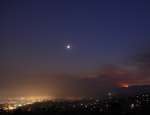 Planets and Fire by Moonlight
9.07.2008
On July 5th, wandering planets, bright stars, and a young crescent Moon graced western skies after sunset. Arrayed along the solar system's ecliptic plane, the three celestial beacons forming this skyscape's eye-catching line-up with the Moon are Saturn (upper left), then Mars, and finally Regulus, alpha star of the constellation Leo.
 Aurora Australis
4.07.2015
Not fireworks, these intense shimmering lights still danced across Earth's night skies late last month, seen here above the planet's geographic south pole. The stunning auroral displays were triggered as a coronal mass ejection blasted from the Sun days earlier impacted the magnetosphere, beginning a widespread geomagnetic storm.
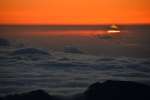 A Green Flash of Spring
9.04.2016
Taken on March 20 from the top of Haleakala on the isle of Maui, planet Earth, the first sunrise of northern spring is pictured in this vacation snapshot. The telephoto view from the volcanic caldera above a sea of clouds also captures an elusive green flash near the Sun's upper limb.
|
January February March April May June July August September October |
|||||||||||||||||||||||||||||||||||||||||||||||||