
|
You entered: light
 Planets on the Wing
6.01.2018
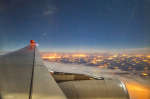
Lately, bright Jupiter and fainter Mars have been easy to spot for early morning skygazers. Before dawn on January 7 the two naked-eye planets will reach a close conjunction near the horizon, only 1/4 degree apart in predawn eastern skies. That apparent separation corresponds to about half the angular diameter of a Full Moon.
 The Year of Distant Supernovae
31.12.1998
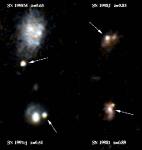
Distant supernovae were among topics at the forefront of astronomy during 1998. Two independent groups raced to deploy large telescopes to scan the sky, discovering and analyzing far-off supernovae with the promise of calibrating the geometry of our universe.
 The Cygnus Loop
23.06.2001
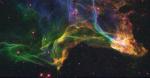
The shockwave from a 20,000 year-old supernova in the constellation of Cygnus supernova explosion is still expanding into interstellar space. The collision of this fast moving wall of gas with a stationary cloud...
 The Small Cloud of Magellan
19.07.1997
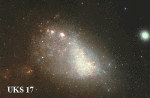
The southern sky contains wonders almost unknown in the north. These wonders include the Large and Small Magellanic Clouds: small irregular galaxies orbiting our own larger Milky Way spiral galaxy. The Small Magellanic Cloud (SMC), pictured here, is about 250,000 light years away.
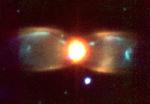 The Butterfly Planetary Nebula
21.10.1997
As stars age, they throw off their outer layers. Sometimes a highly symmetric gaseous planetary nebula is created, as is the case in M2-9, also called the Butterfly. Most planetary nebulae show this bipolar appearance, although some appear nearly spherical.
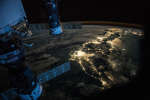 Cities at Night
5.03.2016
Looking toward the south from an altitude of 400 kilometers, this stunning snapshot from orbit finds bright lights of Tokyo and cities across central and southern Japan, planet Earth shining upward through broken clouds. The spacefaring perspective was captured last July by astronaut Scott Kelly during his stay on board the International Space Station.
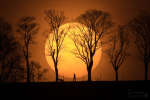 Man, Dog, Sun
11.04.2017
This was supposed to be a shot of trees in front of a setting Sun. Sometimes, though, the unexpected can be photogenic. During some planning shots, a man walking his dog unexpected crossed the ridge. The result was so striking that, after cropping, it became the main shot.
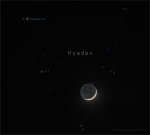 Moon in the Hyades
20.04.2018
Have you seen the Moon lately? On April 18, its waxing sunlit crescent moved through planet Earth's night across a background of stars in the Hyades. Anchored by bright star Aldebaran, the nearby, V-shaped star cluster and complete lunar orb appear in this telephoto image.
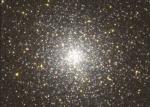 Globular Cluster 47 Tucanae
22.04.2001
Stars come in bunches. Of the over 200 globular star clusters that orbit the center of our Milky Way Galaxy, 47 Tucanae is the second brightest globular cluster (behind Omega Centauri). Known to some affectionately as 47 Tuc or NGC 104, it is only visible from the Southern Hemisphere.
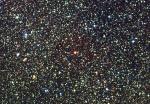 Proxima Centauri: The Closest Star
15.07.2002
What is the closest star to our Sun? It is Proxima Centauri, the nearest member of the Alpha Centauri triple star system. Light takes only 4.22 years to reach us from Proxima Centauri. This...
|
January February March April May June July August September October |
|||||||||||||||||||||||||||||||||||||||||||||||||