
|
You entered: stars
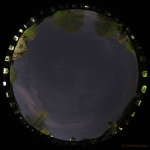 A Spring Sky Over Hirsau Abbey
6.05.2009
What's in the sky tonight? When strolling outside just after sunset, even if just going out to your car, a casual glance upwards can reveal a beautiful night sky also seen by many people across the Earth.
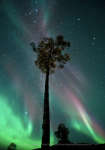 September Aurora
21.09.2012
September's equinox arrives tomorrow as the Sun crosses the celestial equator heading south. The event marks the astronomical beginning of spring in the southern hemisphere and autumn in the north. And though the connection is still puzzling, the equinox seasons bring an increase in geomagnetic storms.
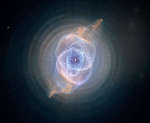 The Cat's Eye Nebula from Hubble
8.11.2014
To some, it may look like a cat's eye. The alluring Cat's Eye nebula, however, lies three thousand light-years from Earth across interstellar space. A classic planetary nebula, the Cat's Eye (NGC 6543) represents a final, brief yet glorious phase in the life of a sun-like star.
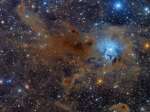 NGC 7023: The Iris Nebula
6.05.2016
These cosmic clouds have blossomed 1,300 light-years away, in the fertile starfields of the constellation Cepheus. Called the Iris Nebula, NGC 7023 is not the only nebula to evoke the imagery of flowers, though.
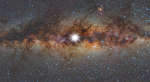 Solstice Sun and Milky Way
21.12.2017
Welcome to December's solstice, first day of winter in the north and summer for the southern hemisphere. Astronomical markers of the seasons, solstice and equinox dates are based on the Sun's place in its annual journey along the ecliptic, through planet Earth's sky.
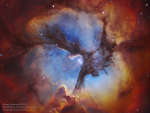 In the Center of the Trifid Nebula
1.11.2020
What's happening at the center of the Trifid Nebula? Three prominent dust lanes that give the Trifid its name all come together. Mountains of opaque dust appear near the bottom, while other dark filaments of dust are visible threaded throughout the nebula.
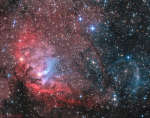 The Tulip and Cygnus X-1
1.09.2022
Framing a bright emission region, this telescopic view looks out along the plane of our Milky Way Galaxy toward the nebula rich constellation Cygnus the Swan. Popularly called the Tulip Nebula, the reddish glowing cloud of interstellar gas and dust is also found in the 1959 catalog by astronomer Stewart Sharpless as Sh2-101.
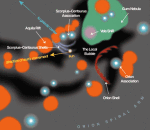 The Local Bubble and the Galactic Neighborhood
12.04.2000
What surrounds the Sun in this neck of the Milky Way Galaxy? Our current best guess is depicted in the above map of the surrounding 1500 light years constructed from various observations and deductions.
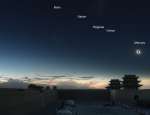 Planets, Great Wall, and Solar Eclipse
18.07.2009
This dramatic skyscape was recorded during the August 2008 total solar eclipse. The Moon's silhouette surrounded by a glistening solar corona hangs above the Jiayuguan Fort along the western edge of the Great Wall of China.
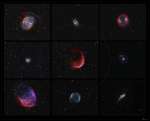 Planetary Nebula Project
18.02.2011
Cast off by dying sunlike stars, planetary nebulae are a brief but glorious final phase of stellar evolution. The gaseous shrouds are ionized by an extremely hot central source, the shrinking core of a star running out of fuel for nuclear fusion.
|
January February March April May June July August September October |
|||||||||||||||||||||||||||||||||||||||||||||||||