
|
You entered: stars
 The Snows of Churyumov Gerasimenko
6.01.2024
You couldn't really be caught in this blizzard while standing by a cliff on periodic comet 67P/Churyumov-Gerasimenko. Orbiting the comet in June of 2016, the Rosetta spacecraft's narrow angle camera did record...
 Fermi s Gamma Ray Sky
21.03.2009
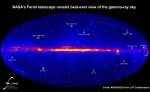
Scanning the entire sky in gamma-rays, photons with over 50 million times the energy of visible light, the Fermi mission's Large Area Telescope (LAT) explores the high-energy universe. This all-sky map constructed from...
 SNR 0103 72.6: Oxygen Supply
13.08.2005
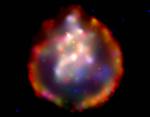
A supernova explosion, a massive star's inevitable and spectacular demise, blasts back into space debris enriched in the heavy elements forged in its stellar core. Incorporated into future stars and planets, these are the elements ultimately necessary for life. Seen here in a false-color x-ray image, supernova remnant SNR 0103-72
 The Big Picture
11.04.2009
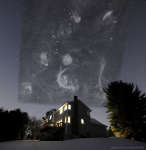
Intricate, glowing nebulae that shine in planet Earth's night sky are beautiful to look at in deep images made with telescopes and sensitive cameras. But they are faint and otherwise invisible to the naked-eye. That makes their relative location and extent on the sky difficult to appreciate.
 The Small Cloud of Magellan
3.09.2010
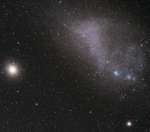
Portuguese navigator Ferdinand Magellan and his crew had plenty of time to study the southern sky during the first circumnavigation of planet Earth. As a result, two celestial wonders easily visible for southern hemisphere skygazers are known as the Clouds of Magellan.
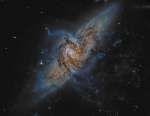 NGC 3314: When Galaxies Overlap
15.07.2011
NGC 3314 is actually two large spiral galaxies which just happen to almost exactly line up. The foreground spiral is viewed nearly face-on, its pinwheel shape defined by young bright star clusters. But against the glow of the background galaxy, dark swirling lanes of interstellar dust appear to dominate the face-on spiral's structure.
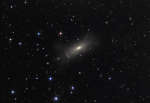 Shell Galaxy NGC 7600
23.12.2011
Similar in size to the Milky Way, elliptical galaxy NGC 7600 is about 150 thousand light-years distant. In this deep image, spanning about 1/2 degree on the sky toward the constellation Aquarius, NGC 7600 sports a remarkable outer halo of nested shells and broad circumgalactic structures.
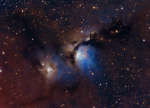 Stardust and Starlight in M78
8.03.2019
Interstellar dust clouds and bright nebulae abound in the fertile constellation of Orion. One of the brightest, M78, is near the center in this colorful telescopic view, covering an area north of Orion's belt. At a distance of about 1,500 light-years, the bluish nebula itself is about 5 light-years across.
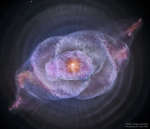 The Cats Eye Nebula in Optical and Xray
1.05.2019
To some it looks like a cat's eye. To others, perhaps like a giant cosmic conch shell. It is actually one of brightest and most highly detailed planetary nebula known, composed of gas expelled in the brief yet glorious phase near the end of life of a Sun-like star.
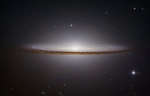 Messier 104
23.04.2022
A gorgeous spiral galaxy, Messier 104 is famous for its nearly edge-on profile featuring a broad ring of obscuring dust lanes. Seen in silhouette against an extensive central bulge of stars, the swath of cosmic dust lends a broad brimmed hat-like appearance to the galaxy suggesting a more popular moniker, the Sombrero Galaxy.
|
January February March April May June July August September October |
|||||||||||||||||||||||||||||||||||||||||||||||||