
|
You entered: NASA
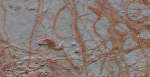 The Surface of Europa
19.05.2016
An enhanced-color view, this image covers a 350 by 750 kilometer swath across the surface of Jupiter's tantalizing moon Europa. The close-up combines high-resolution image data with lower resolution color data from observations made in 1998 by the Galileo spacecraft.
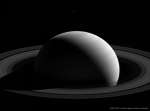 Behind Saturn
1.08.2016
What's behind Saturn? The first answer is the camera itself, perched on the Cassini spacecraft currently orbiting behind the planet with the most grand ring system in our Solar System. The unusual perspective...
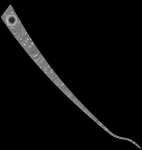 Noodle Mosaic of Saturn
28.07.2017
On April 26 the Cassini spacecraft swooped toward Saturn on the first of its Grand Finale dives between Saturn and rings. In this long, thin, noodle mosaic, a rapid series of 137 low resolution images captured by Cassini's wide-angle camera track its progress across the gas giant's swirling cloud tops.
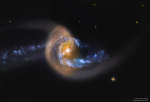 NGC 7714: Starburst after Galaxy Collision
9.10.2019
Is this galaxy jumping through a giant ring of stars? Probably not. Although the precise dynamics behind the featured image is yet unclear, what is clear is that the pictured galaxy, NGC 7714, has been stretched and distorted by a recent collision with a neighboring galaxy.
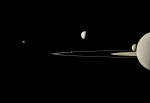 Moons of Saturn
17.10.2019
On July 29, 2011 the Cassini spacecraft's narrow-angle camera took this snapshot and captured 5 of Saturn's moons, from just above the ringplane. Left to right are small moons Janus and Pandora respectively 179 and 81 kilometers across, shiny 504 kilometer diameter Enceladus, and Mimas, 396 kilometers across, seen just next to Rhea.
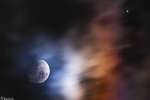 APOD: 2020 September 2 Б Jupiter and the Moons
2.09.2020
How many moons do you see? Many people would say one, referring to the Earth's Moon, prominent on the lower left. But take a closer look at the object on the upper right.
 Webb s Rho Ophiuchi
13.07.2023
A mere 390 light-years away, Sun-like stars and future planetary systems are forming in the Rho Ophiuchi molecular cloud complex, the closest star-forming region to our fair planet. The James Webb Space Telescope's NIRCam peered into the nearby natal chaos to capture this infrared image at an inspiring scale.
 APOD: 2025 January 12 Б Mimas: Small Moon with a Big Crater
12.01.2025
Whatever hit Mimas nearly destroyed it. What remains is one of the largest impact craters on one of Saturn's smallest round moons. Analysis indicates that a slightly larger impact would have destroyed Mimas entirely.
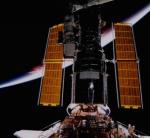 Hubble Holiday
24.12.1999
How would you like to spend your holiday in low earth orbit? That's what the crew of the space shuttle Discovery is doing as they deliver six new gyros and a faster main computer to the orbiting Hubble Space Telescope.
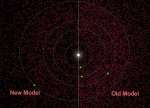 Asteroids Near Earth
1.10.2011
Though the sizes are not to scale, the Sun and planets of the inner solar system are shown in this illustration, where each red dot represents an asteroid. New results from NEOWISE, the infrared...
|
January February March April May June July August September October |
|||||||||||||||||||||||||||||||||||||||||||||||||