
|
You entered: NASA
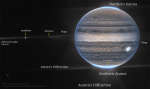 APOD: 2026 January 18 Б Jupiter from the Webb Space Telescope
18.01.2026
This infrared view of Jupiter by Webb is illuminating. High-resolution infrared images of Jupiter from the James Webb Space Telescope (Webb) reveal, for example, differences between high-floating bright clouds -- including the Great Red Spot -- and low-lying dark clouds.
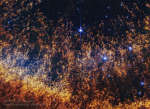 APOD: 2026 August 4 Б Curious Cometary Knots in the Helix Nebula
4.08.2026
What causes unusual knots of gas and dust in planetary nebulas? Seen also in the Ring Nebula, the Dumbbell Nebula and NGC 2392, the knots' existence was not initially predicted, and their origins are still not well understood.
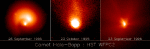 Comet Hale-Bopp Inbound
19.12.1996
Headed toward the inner Solar System, the much anticipated Comet Hale-Bopp has promised to put on a big show next spring. The comet's apparent brightness is currently approaching 4th magnitude and its inbound journey has been closely followed by many observers.
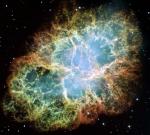 Crab Nebula Mosaic from HST
2.12.2005
The Crab Nebula is cataloged as M1, the first object on Charles Messier's famous list of things which are not comets. In fact, the cosmic Crab is now known to be a supernova remnant, an expanding cloud of debris from the death explosion of a massive star.
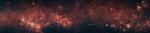 GLIMPSE the Milky Way
16.12.2005
Scroll right and gaze through the dusty plane of our Milky Way Galaxy in infrared light. The cosmic panorama is courtesy of the Galactic Legacy Infrared Mid-Plane Survey Extraordinaire (GLIMPSE) project and the Spitzer Space Telescope.
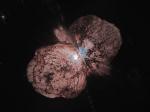 Doomed Star Eta Carinae
26.03.2006
Eta Carinae may be about to explode. But no one knows when - it may be next year, it may be one million years from now. Eta Carinae's mass - about 100 times greater than our Sun - makes it an excellent candidate for a full blown supernova.
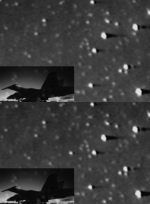 Astronomy From An F-18
28.01.2000
In an era of blossoming ground and space-based observatories, astronomers are also pushing the envelope with airborne instrumentation - successfully capturing an asteroid occultation from a high performance jet aircraft. This blinking animation represents...
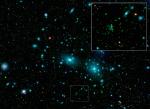 Dwarf Galaxies in the Coma Cluster
31.05.2007
In visible light images, over a thousand galaxies are seen to lie within a volume about 20 million light-years across in the rich Coma Galaxy Cluster. But infrared images of the Coma Cluster have now been used to add thousands more to the Coma's galaxy count in the form of previously undiscovered dwarf galaxies.
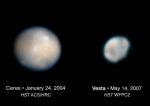 Small Worlds Ceres and Vesta
22.06.2007
Ceres and Vesta are, respectively, only around 950 kilometers and 530 kilometers in diameter - about the size of Texas and Arizona. But they are two of the largest of over 100,000 minor bodies orbiting in the main asteroid belt between Mars and Jupiter.
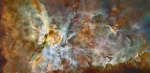 Carina Nebula Panorama from Hubble
24.05.2009
In one of the brightest parts of Milky Way lies a nebula where some of the oddest things occur. NGC 3372, known as the Great Nebula in Carina, is home to massive stars and changing nebula.
|
January February March April May June July August September October |
|||||||||||||||||||||||||||||||||||||||||||||||||