
|
You entered: NASA
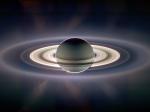 In the Shadow of Saturn
16.10.2006
In the shadow of Saturn, unexpected wonders appear. The robotic Cassini spacecraft now orbiting Saturn recently drifted in giant planet's shadow for about 12 hours and looked back toward the eclipsed Sun. Cassini saw a view unlike any other.
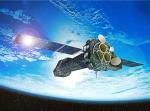 XMM Launched
21.12.1999
X-ray astronomy entered a golden age earlier this month with the successful launch of the X-ray Multi-Mirror (XMM) satellite. XMM's three huge telescope barrels each hold 58 concentric cylindrical mirrors, together totaling a surface area rivaling a tennis court.
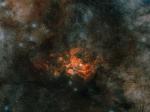 Star Forming Region NGC 6357
20.12.2006
For reasons unknown, NGC 6357 is forming some of the most massive stars ever discovered. Near the more obvious Cat's Paw nebula, NGC 6357 houses the open star cluster Pismis 24, home to these tremendously bright and blue stars.
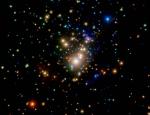 X Ray Stars of Orion
6.10.2007
The stars of Orion shine brightly in visible light in planet Earth's night sky. The constellation harbors the closest large stellar nursery, the Great Nebula of Orion, a mere 1,500 light-years away.
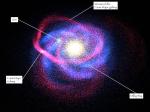 The Closest Galaxy: Canis Major Dwarf
4.11.2007
What is the closest galaxy to the Milky Way? The new answer to this old question is the Canis Major dwarf galaxy. For many years astronomers thought the Large Magellan Cloud (LMC) was closest, but its title was supplanted in 1994 by the Sagittarius dwarf galaxy.
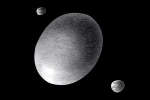 Haumea of the Outer Solar System
23.09.2008
One of the strangest objects in the outer Solar System was classified as a dwarf planet last week and given the name Haumea. This designation makes Haumea the fifth designated dwarf planet after Pluto, Ceres, Eris, and Makemake. Haumea's smooth but oblong shape make it extremely unusual.
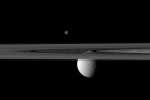 Moons Beyond the Rings of Saturn
12.07.2010
What's happened to that moon of Saturn? Nothing -- Saturn's moon Rhea is just partly hidden behind Saturn's rings. In April, the robotic Cassini spacecraft now orbiting Saturn took this narrow-angle view looking across the Solar System's most famous rings.
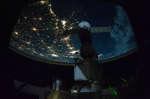 Night Lights
4.11.2010
Constellations of lights sprawl across this night scene, but they don't belong in the skies of planet Earth. Instead, the view looks down from the International Space Station as it passed over the United States along the northern Gulf Coast on October 29. A Russian Soyuz spacecraft is docked in the foreground.
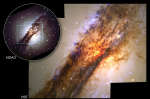 The Center of Centaurus A
7.11.2010
A fantastic jumble of young blue star clusters, gigantic glowing gas clouds, and imposing dark dust lanes surrounds the central region of the active galaxy Centaurus A. This mosaic of Hubble Space Telescope images taken in blue, green, and red light has been processed to present a natural color picture of this cosmic maelstrom.
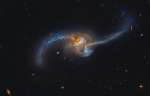 Merging NGC 2623
19.10.2012
NGC 2623 is really two galaxies that are becoming one. Seen to be in the final stages of a titanic galaxy merger, the pair lies some 300 million light-years distant toward the constellation Cancer.
|
January February March April May June July August September October |
|||||||||||||||||||||||||||||||||||||||||||||||||