
|
You entered: light
 A Wintry Shower
16.12.2017
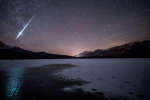
Four Geminids flash through northern skies in this wintry night skyscape. The bright fireball and 3 fainter meteors were captured in a single 10 second exposure, near the peak of December's Geminid meteor shower.
 Martian Chiaroscuro
14.04.2018
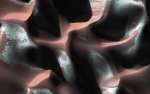
Deep shadows create dramatic contrasts between light and dark in this high-resolution close-up of the martian surface. Recorded on January 24, 2014 by the HiRISE camera onboard the Mars Reconnaissance Orbiter, the scene spans about 1.5 kilometers.
 North Celestial Aurora
18.05.2024
Graceful star trail arcs reflect planet Earth's daily rotation in this colorful night skyscape. To create the timelapse composite, on May 12 consecutive exposures were recorded with a camera fixed to a tripod on the shores of the Ashokan Reservoir, in the Catskills region of New York, USA.
 Ganymede: The Largest Moon in the Solar System
20.06.2000
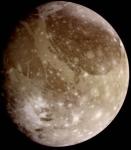
If Ganymede orbited the Sun, it would be considered a planet. The reason is that Jupiter's moon Ganymede is not only the largest moon in the Solar System, it is larger than planets Mercury and Pluto.
 M1: The Exploding Crab Nebula
22.11.1995
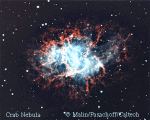
The Crab Nebula resulted from a star that exploded - a supernova. The outer layers of the star were thrown violently into space, while the inner core collapsed to form a neutron star. This neutron...
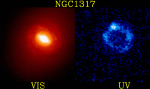 Starburst Ring in Galaxy NGC 1317
11.12.1996
Where do stars form? A typical place is an area of dense nebular gas common to arms in spiral galaxies. Sometimes, however, a burst of star formation can occur with unusual geometry. Nearby galaxy NGC 1317 shows such an unusual ring of star formation surrounding its barred nucleus.
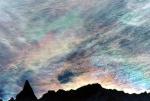 Iridescent Clouds Over Aiguille de la Tsa
14.10.2003
Before the sun rose over the mountains, iridescent colors danced across the sky. The unexpected light show was caused by a batch of iridescent clouds, and captured on film in early September in Arolla, Wallis, Switzerland. The peak in the foreground of the above image is Aiguille de la Tsa.
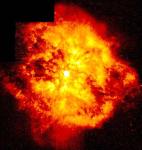 WR124: Stellar Fireball
9.11.1998
Some stars explode in slow motion. Rare, massive Wolf-Rayet stars are so tumultuous and hot they are disintegrating right before our telescopes. Glowing gas globs each over 30 times more massive than the Earth are being expelled by a violent stellar wind.
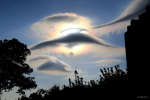 Unusual Clouds over Hong Kong
2.03.2016
What's that in the sky? Earlier this month, in the sky high above Hong Kong, China, not just one unusual type of cloud appeared -- but two. In the foreground was a long lenticular cloud, a cloud that forms near mountains from uprising air and might appear to some as an alien spaceship.
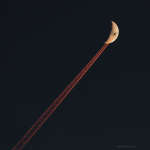 Plane Crossing a Crescent Moon
12.02.2019
No, this is not a good way to get to the Moon. What is pictured is a chance superposition of an airplane and the Moon. The contrail would normally appear white, but the large volume of air toward the setting Sun preferentially knocks away blue light, giving the reflected trail a bright red hue.
|
January February March April May June July August September October |
|||||||||||||||||||||||||||||||||||||||||||||||||