
|
You entered: light
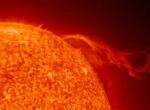 Escape From The Sun
20.11.1997
Twisted magnetic fields arching from the solar surface can trap ionized gas, suspending it in huge looping structures. These majestic plasma arches are seen as prominences above the solar limb. On September 14, this...
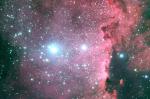 Hot Stars in the Southern Milky Way
22.12.2001
Hot blue stars, red glowing hydrogen gas, and dark, obscuring dust clouds are strewn through this dramatic region of the Milky Way in the southern constellation of Ara (the Altar). About 4,000 light-years from Earth, the stars at the left are young, massive, and energetic.
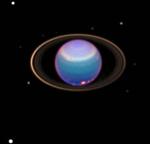 Infrared Uranus
20.10.1998
The Sun's third largest planet usually looks quite dull. Uranus typically appears as a featureless small spot in a small telescope or a featureless large orb in a large telescope. Last August, however...
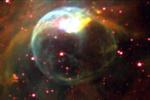 NGC 7635: The Bubble Nebula
17.11.1998
What created this huge space bubble? A massive star that is not only bright and blue, but also emitting a fast stellar wind of ionized gas. The Bubble Nebula is actually the smallest...
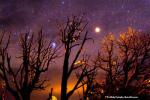 A Martian Halloween
31.10.2005
From sunset to sunrise, an unusually bright yellowish orb will hang in the sky this Halloween: Mars. Yesterday, Earth passed Mars as they orbited the Sun, bringing Mars closer than it will be for the next thirteen years. Tonight though, Mars will be nearly as bright as last night, a beacon of extraterrestrial spookiness.
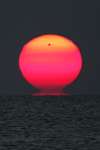 When Venus Rises with the Sun
8.06.2012
This dramatic telephoto view across the Black Sea on June 6 finds Venus rising with the Sun, the planet in silhouette against a ruddy and ragged solar disk. Of course, the reddened light...
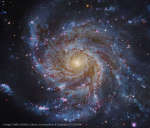 M101: The Pinwheel Galaxy
14.06.2015
Why do many galaxies appear as spirals? A striking example is M101, shown above, whose relatively close distance of about 27 million light years allows it to be studied in some detail. Observational evidence...
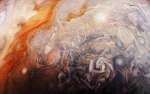 Painting with Jupiter
7.04.2018
Brush strokes of Jupiter's signature atmospheric bands and vortices form this planetary post-impressionist work of art. The creative image uses actual data from the Juno spacecraft's JunoCam. To paint on the digital canvas, a image with light and dark tones was chosen for processing and an oil-painting software filter applied.
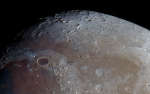 Mare Frigoris
8.10.2020
Lighter than typically dark, smooth, mare the Mare Frigoris lies in the far lunar north. Also known as the Sea of Cold, it stretches across the familiar lunar nearside in this close up of the waxing gibbous Moon's north polar region. Dark-floored, 95 kilometer wide crater Plato is just left of the center.
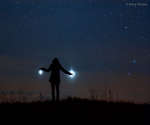 APOD: 2026 June 7 Б Jupiter and Venus from Earth
7.06.2026
It was visible around the world. The sunset conjunction of Jupiter (left) and Venus (right) in 2012 was visible almost no matter where you lived on Earth. Anyone on our planet with a clear western horizon at sunset could see them.
|
January February March April May June July August September October |
|||||||||||||||||||||||||||||||||||||||||||||||||