
|
You entered: light
 APOD: 2024 September 1 Б The Moon Dressed Like Saturn
1.09.2024
Why does Saturn appear so big? It doesn't -- what is pictured are foreground clouds on Earth crossing in front of the Moon. The Moon shows a slight crescent phase with most of its surface visible by reflected Earthlight, known as Da Vinci glow.
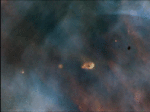 Proplyds: Infant Solar Systems?
17.10.1996
Are planets common in our galaxy? Strong evidence that the answer is "yes" was provided in this 1994 image made by the Hubble Space Telescope . A close-up of the Orion Nebulae, it reveals what seem to be disks of dust and gas surrounding newly formed stars.
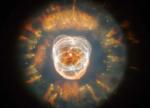 The Eskimo Nebula from Hubble
7.12.2003
In 1787, astronomer William Herschel discovered the Eskimo Nebula. From the ground, NGC 2392 resembles a person's head surrounded by a parka hood. In 2000, the Hubble Space Telescope imaged the Eskimo Nebula. From space, the nebula displays gas clouds so complex they are not fully understood.
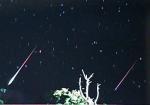 Bright Leonids
19.11.1998
Rich in bright and awesome fireballs, the Leonid Meteor Shower came early this year. In fact, judging from meteor watcher reports the peak came nearly 15 hours earlier than the best predictions. Observers...
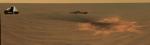 Heat Shield Impact Crater on Mars
9.02.2005
Broken metal and scorched Mars make the impact site of Opportunity's heat shield one of the more interesting sites inspected by the rolling robot. Visible on the image left is the conical outer hull of the shattered heat shield expelled by Opportunity as it plummeted toward Mars last year.
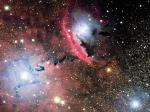 Stars, Dust and Nebula in NGC 6559
9.05.2005
When stars form, pandemonium reigns. A textbook case is the star forming region NGC 6559. Visible above are red glowing emission nebulas of hydrogen, blue reflection nebulas of dust, dark absorption nebulas of dust, and the stars that formed from them.
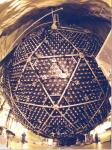 The Sudbury Neutrino Detector
23.06.1999
Two thousand meters below the ground, a giant sphere has begun to detect nearly invisible particles. These particles, neutrinos, are extremely abundant in the universe but usually go right through just about everything.
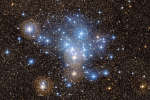 Open Cluster M25
31.08.2009
Many stars like our Sun were formed in open clusters. The above pictured open cluster, M25, contains thousands of stars and is about two thousand light years distant. The stars in this cluster all formed together about 90 million years ago. The bright young stars in M25 appear blue.
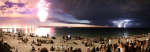 Comet Between Fireworks and Lightning
29.05.2011
Sometimes the sky itself is the best show in town. In January 2007, people from Perth, Australia gathered on a local beach to watch a sky light up with delights near and far. Nearby, fireworks exploded as part of Australia Day celebrations. On the far right, lightning from a thunderstorm flashed in the distance.
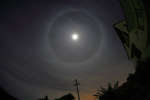 A Halo Around the Moon
20.11.2012
Have you ever seen a halo around the Moon? This fairly common sight occurs when high thin clouds containing millions of tiny ice crystals cover much of the sky. Each ice crystal acts like a miniature lens.
|
January February March April May June July August September October |
|||||||||||||||||||||||||||||||||||||||||||||||||