
|
You entered: light
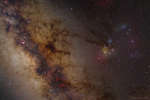 A Wide Field Image of the Galactic Center
6.01.2012
From Sagittarius to Scorpius, the central Milky Way is a truly beautiful part of planet Earth's night sky. The gorgeous region is captured in this wide field image spanning about 30 degrees.
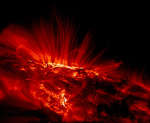 Sunspot Loops in Ultraviolet
26.01.2014
It was a quiet day on the Sun. The above image shows, however, that even during off days the Sun's surface is a busy place. Shown in ultraviolet light, the relatively cool dark regions have temperatures of thousands of degrees Celsius.
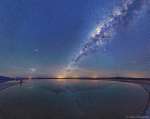 Milky Way above Atacama Salt Lagoon
16.09.2014
Galaxies, stars, and a serene reflecting pool combine to create this memorable land and skyscape. The featured panorama is a 12-image mosaic taken last month from the Salar de Atacama salt flat in northern Chile. The calm water is Laguna Cejar, a salty lagoon featuring a large central sinkhole.
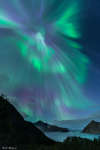 Auroral Corona over Norway
14.10.2014
Higher than the highest mountain lies the realm of the aurora. Auroras rarely reach below 60 kilometers, and can range up to 1000 kilometers. Aurora light results from energetic electrons and protons striking atoms and molecules in the Earth's atmosphere.
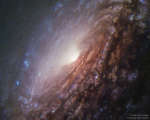 In the Center of Spiral Galaxy NGC 5033
8.01.2017
What's happening in the center of spiral NGC 5033? Many things -- some circular, some energetic, and some not well understood. NGC 5033 is known as a Seyfert galaxy because of the great activity seen in its nucleus.
 APOD: 2023 November 5 Б Creature Aurora Over Norway
4.11.2023
It was Halloween and the sky looked like a creature. Exactly which creature, the astrophotographer was unsure (but possibly you can suggest one). Exactly what caused this eerie apparition in 2013 was sure: one of the best auroral displays that year. This spectacular aurora had an unusually high degree of detail.
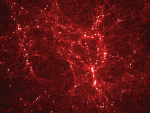 The Early Universe
14.06.1997
What did our universe look like when it was young? To answer this, cosmologists run sophisticated computer programs tracking the locations of millions of particles. The above animated frame is the result of such a calculation and shows how our universe might have looked when it was just a fracton of its current age.
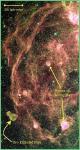 Stellar Laboratories in the LMC
25.07.1997
Stars are evolving in the Large Magellanic Clouds (LMC). This is particularly evident in the above close-up of the LMC's edge, which appears about as large as the full moon. Visible only...
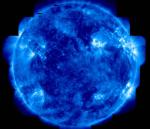 Autumn and the Active Sun
23.09.1998
As the Sun heads South, crossing the celestial equator today at 1:37 a.m. Eastern Time, Autumn begins for Earth's Northern Hemisphere. This Autumnal Equinox finds an increasingly active Sun steadily approaching a solar cycle maximum expected around the year 2003.
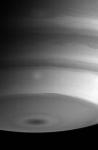 Southern Saturn from Cassini
18.10.2004
What happens to Saturn's pervasive clouds at its South Pole? Visible in the above image of Saturn are bright bands, dark belts and a dark spot right over the South Pole. The above...
|
January February March April May June July August September October |
|||||||||||||||||||||||||||||||||||||||||||||||||